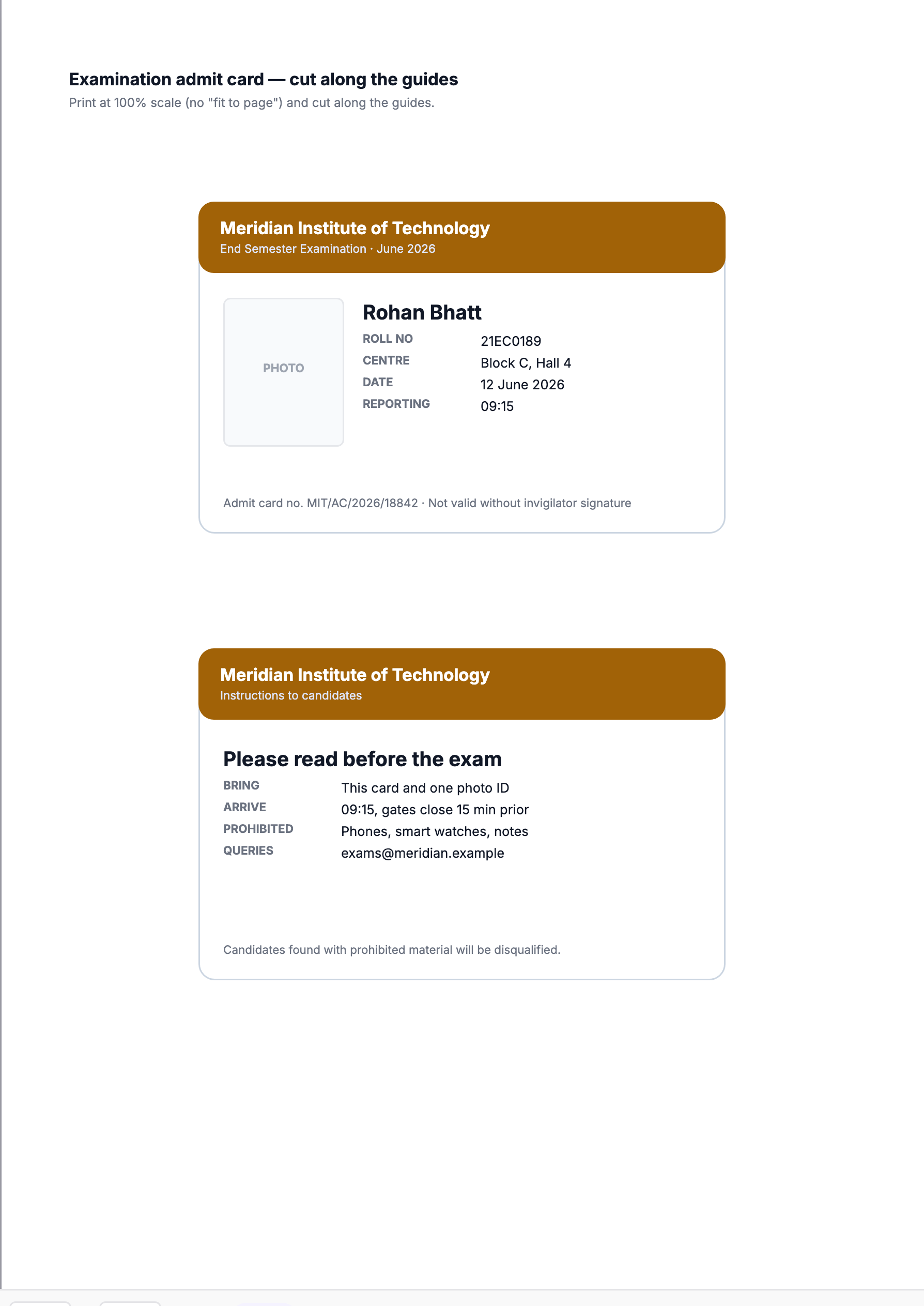
An admit card is a candidate's permission to sit an examination. It also carries the logistics — where, when, and what they can bring — to people who are frequently anxious and reading it at the last minute.
Clarity matters more here than on almost any other document in this gallery, because the cost of a misunderstanding is someone missing an exam.
Two faces: credentials and instructions
The template splits them deliberately.
The front is what an invigilator checks: institution, exam, candidate name, roll number, centre, hall, date, reporting time, and space for a photo and signature.
The back is what the candidate needs the night before: what to bring, when to arrive, what is prohibited, and who to contact.
Mixing the two produces a card that is dense to check and easy to misread.
Reporting time is not the exam time
State the reporting time prominently and say what happens after it. "Report by 09:15, gates close 15 minutes before the exam begins" removes an entire category of dispute at the door.
If the exam starts at 10:00 and the card only says 10:00, some candidates will arrive at 09:58 and be genuinely surprised to be refused.
Be specific about the centre
A centre name alone is not enough in a city where an institution has several campuses. Give the building and hall — "Block C, Hall 4" — and, if the venue is not obvious, the full address.
Candidates travelling to an unfamiliar location on a stressful morning benefit disproportionately from this. It is two extra lines.
The prohibited list should be exhaustive and specific
"Electronic devices" is interpreted differently by everyone. Name the items: phones, smart watches, wireless earbuds, programmable calculators, notes.
And state the consequence, because a rule with no stated consequence is treated as advisory. The template's footer does this in one line.
The invigilator signature block
Many examination bodies require the card to be signed by the invigilator during the exam, and it becomes the candidate's proof of attendance.
If yours does, keep that block and say explicitly on the card that it is not valid without the signature — otherwise candidates discard it afterwards and then need it.
Numbering
Each admit card should carry its own number, distinct from the roll number. It is what identifies this specific document if one is reported lost or a duplicate is issued, and it lets you track issuance separately from registration.
Producing them
Admit cards are generated for an entire examination cohort at once, from data that already exists: registrations, centre allocations and the timetable.
Generating one card per candidate from that data is faster than any manual process and removes the allocation errors — a candidate sent to the wrong centre because a row was copied incorrectly is the failure mode worth engineering out.