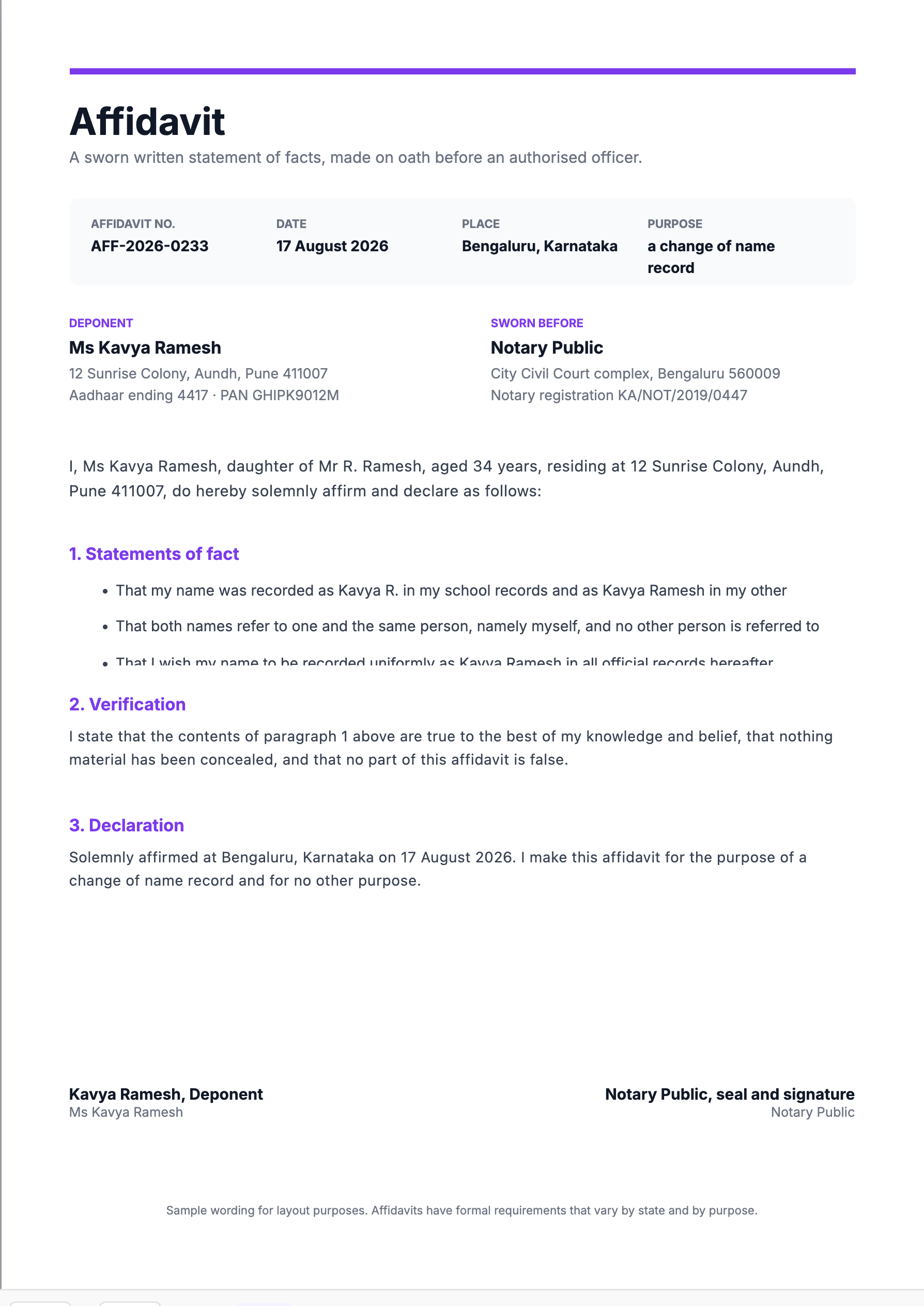
An affidavit is a statement signed on oath, before someone authorised to take it, for one stated purpose. Its layout follows from that: who is speaking, what they assert, that they know it to be true, and where they said so.
What an affidavit contains
| Field | Why |
|---|---|
| Affidavit number and date | So it can be referred to and filed. |
| Place | Where it was sworn — this appears again in the declaration. |
| Purpose | The single matter it was made for. |
| Deponent | Name, parentage, age, address and identification. |
| Statements of fact | Numbered, one assertion each. |
| Verification | That the statements are true and nothing is concealed. |
| Declaration | Sworn at a named place on a named date, for that purpose only. |
| Attesting officer | The notary or oath commissioner, with registration details. |
The deponent block does more work than it looks
"Ms Kavya Ramesh, daughter of Mr R. Ramesh, aged 34 years, residing at..." is not ceremony. Names repeat, and parentage, age and address together identify one person out of the several who share the name. Age is stated in completed years as at the date of swearing.
One habit worth adopting: identify yourself with a partial reference. The sample shows "Aadhaar ending 4417 · PAN GHIPK9012M" rather than a full number. An affidavit is photocopied, scanned and left in files by people you will never meet — give the receiving office enough to match you against the record it already holds, and no more.
Write the statements as numbered facts, one fact each
Each paragraph starts "That", carries a single assertion, and stops. This looks old-fashioned and it is genuinely useful: anyone who wants to accept, question or correct part of your affidavit does it by paragraph number.
Facts only. An affidavit is not the place for argument, opinion, or a conclusion about what should follow — "that I am therefore entitled to..." is the kind of line that gets one sent back. State what happened and let the office draw the conclusion.
The name-change example shows the usual three-beat shape: what the discrepancy is, that both records refer to the same person and no one else, and what you want recorded going forward. Most affidavits fit that shape.
The verification is not boilerplate
The verification paragraph is what turns a signed page into a sworn one. It says the contents are true to the best of the deponent's knowledge and belief, that nothing material is concealed, and that no part is false.
Knowledge and belief are different things. Facts you witnessed are true to your knowledge; facts you were told, or drew from records, are true to your belief. Where an affidavit mixes both, the conventional form says which paragraphs fall in which category. It costs a sentence and it is the honest way to sign.
Take the words seriously. Swearing something false, or concealing something material, is treated as a serious matter in its own right, quite apart from whatever the affidavit was about. That is also why the declaration narrows the document: made for this purpose "and for no other purpose" stops it being reused somewhere you never intended.
Before you print it
The sample wording is a layout to draft from, not a form to sign as it stands. Affidavits are made before an authorised officer — a notary, an oath commissioner, sometimes a magistrate — and which one is appropriate depends on the purpose. The stamp paper expected, and whether the receiving office has its own prescribed format, vary by state and by situation.
The cheapest check available: before printing anything, ask the office that will receive the affidavit what format they accept. Banks, passport offices, courts and universities frequently have their own text, and a beautifully drafted affidavit in the wrong form is a wasted trip.