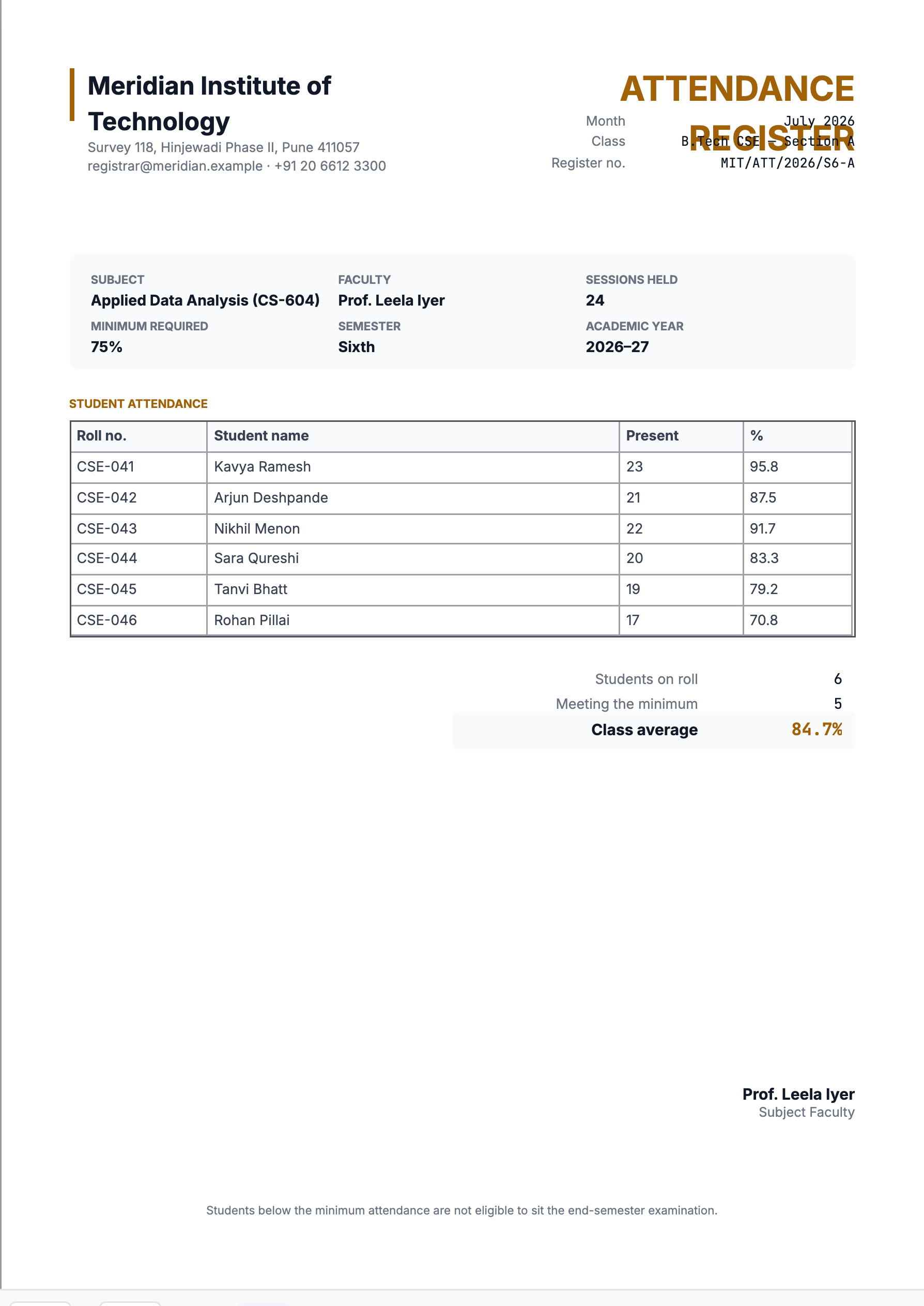
An attendance register is a monthly record with an unusual property: it decides something. At the end of the semester it determines who is allowed to sit the examination, which means every figure on it will eventually be checked by somebody with a strong interest in that figure being different.
What belongs on an attendance register
| Field | Why |
|---|---|
| Register number | So one month's sheet can be cited on its own. |
| Month and academic year | A register covers one month; the year disambiguates it. |
| Subject and code | Attendance is recorded per subject, not per student. |
| Class and semester | Which cohort this sheet belongs to. |
| Faculty | Who conducted the sessions and stands behind the marks. |
| Sessions held | The denominator for every percentage below. |
| Minimum required | The threshold, printed where students can see it. |
| Roll number | The identifier that survives duplicate names. |
| Sessions present | The raw count. |
| Percentage | Derived from those two counts, never entered independently. |
Sessions held is the denominator — record it, do not infer it
A percentage here means nothing without the number of sessions actually conducted, and that is rarely the number timetabled. Classes get cancelled, holidays land mid-week, a lecture is swapped for a departmental guest session that was never yours to count.
If you record 24 sessions and the timetable says 26, every percentage on the sheet is two sessions' worth optimistic — easily enough to move somebody across the threshold. Fix the denominator at the end of the month from what actually happened, write it at the top, and compute everything from it. When a student queries their figure, this is the first number they will challenge.
Leave has to be settled as policy before it becomes arithmetic
Medical leave, duty leave for a sports fixture or a paper presentation, condoned absence — these produce most attendance disputes, and the register does not resolve them. Your institution does, by deciding whether such a session counts as present, is excused and removed from the denominator, or stays absent with a separate condonation process at the end of term.
All three are defensible. Mixing them within one department is not, because two students with identical records end up with different percentages and both can prove it. Settle the rule before term, apply it to everyone, and file the leave approvals where this sheet can point back to them. The register records the outcome; it is not the place to argue the case.
The student who is one session short
Rounding decides examinations. Seventeen present out of 24 is 70.8%; eighteen is 75.0% exactly. A student sitting at 74.6% will ask whether that rounds up, and the honest answer has to match the one you gave last semester.
Two rules keep it clean. Compare the raw fraction against the minimum rather than the rounded display, so 74.6% stays short. And derive the percentage from the two counts instead of typing it — a hand-typed percentage that disagrees with present-over-held is the error most likely to survive every check, because nobody recomputes a number that already looks plausible.
Sign it monthly, and keep the summary line
A register signed at the end of each month is a record. The same figures assembled in November from memory, a marked-up printout and a class group chat is a reconstruction, and it reads like one to anyone reviewing it later.
Keep the three summary figures — students on roll, how many meet the minimum, the class average. That line is what a head of department actually reads, and an average that drops sharply is the fastest signal that something went wrong with the whole month rather than with one student. Students on roll earns its place too: it is the only field that catches somebody who joined late, transferred out, or never appeared at all.