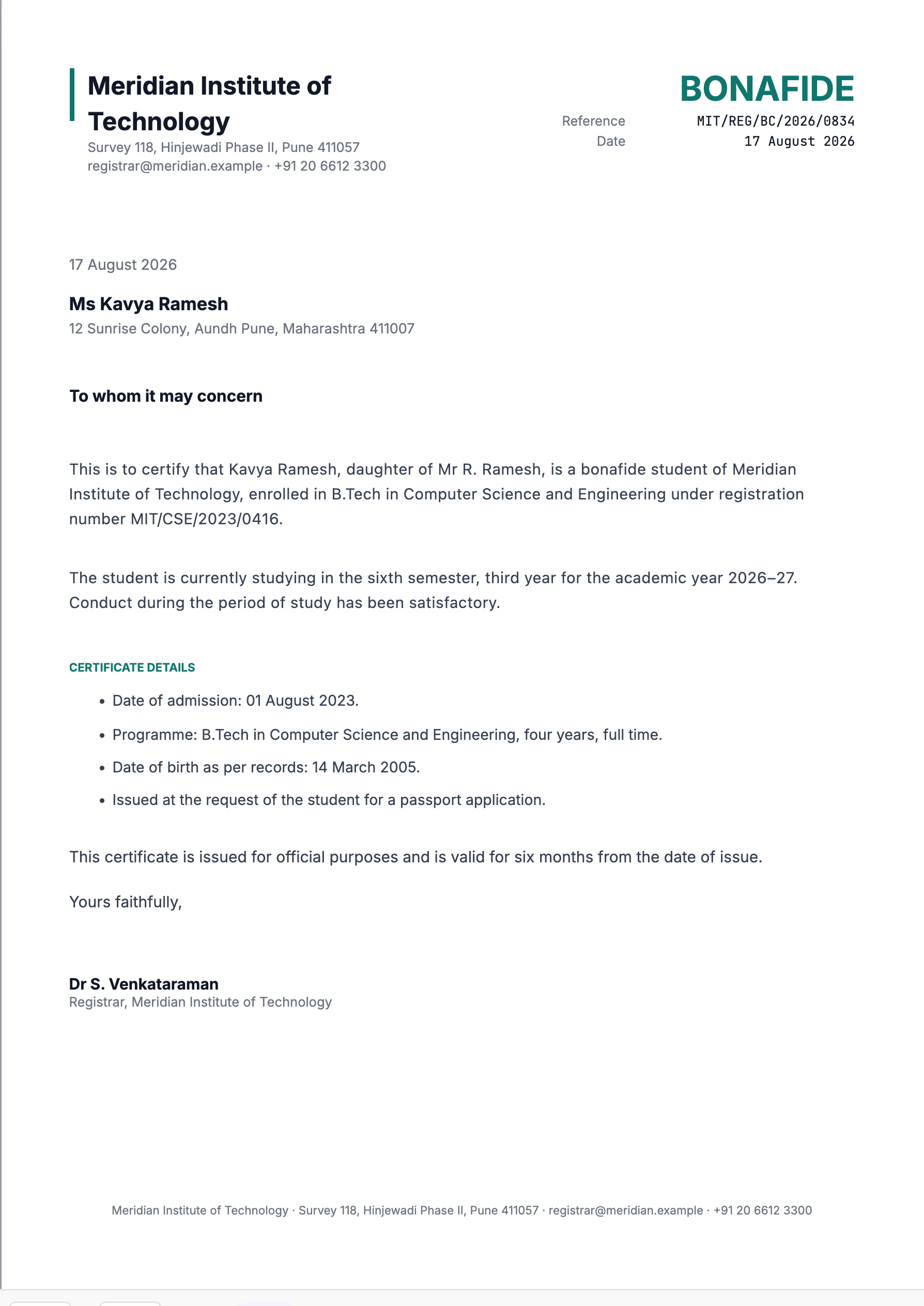
A bonafide certificate answers one question: is this person enrolled here, now. Banks want it before releasing an education loan, passport offices want it from student applicants, and consulates want it before a visa interview.
What belongs on a bonafide certificate
| Field | Why |
|---|---|
| Institution name and address | The certificate is only as good as the office issuing it. |
| Reference number | Points at a register entry the office can look up. |
| Date of issue | Starts the clock on validity. |
| Student name and guardian | Matched against a record the verifier already holds. |
| Registration number | The stable identifier — names repeat, spellings vary. |
| Programme and duration | What the student is enrolled in, and for how long. |
| Current year or semester | Establishes that the enrolment is present, not past. |
| Academic year | Bounds the statement in time. |
| Date of admission | Shows the enrolment is not days old. |
| Date of birth | What most verification processes actually match on. |
| Purpose | What the certificate was requested for. |
| Validity | How long the issuing office will stand behind it. |
It certifies a present fact, so it expires
A degree certificate stays true forever. A bonafide certificate says the student is currently studying in the sixth semester, third year — accurate in August, wrong by the following June.
That is why the template carries a validity line, and why most verifiers refuse anything older than three to six months. State the period rather than leaving it open. A certificate silent on validity gets read conservatively, and the student queues at your counter again.
Say what it was issued for
The purpose line — a passport application, an education loan, a railway concession, a hostel allotment — is not decoration.
It tells the verifier the certificate was produced deliberately for them rather than pulled from a drawer, and it limits the institution: one issued for a passport application in 2026 is not a standing endorsement to be attached to a visa file in 2028. If a student needs certificates for two purposes, issue two, each with its own reference number.
Names and dates have to match the record being checked
Verification is a matching exercise. The passport office compares your certificate against a school record; a bank compares it against a KYC file. Anything that differs — an expanded initial, a transliteration the student prefers, a guardian's name written out where the record has initials — turns a two-minute check into a query.
Use the spelling in your own admission record, not the one on the request slip. The same goes for date of birth, which is why the template says as per records. Where the record and the student's other documents disagree, that is a correction to make in the record first — issuing the convenient date buries the problem inside a document that will be checked.
The reference number is what makes it verifiable
This certificate has no security features and does not need any. Its authority is that the issuing office can confirm it. A reference shaped like MIT/REG/BC/2026/0834 is sequential within the year and points at a register entry recording who it went to, when, and why — so a bank that telephones the registrar gets an answer in a minute.
The register works in the other direction too. An institution that issues these without recording them cannot disown a forged one either; with no counterfoil, there is nothing to check a presented document against.
Sign with an office a verifier recognises. Registrar or principal carries weight in a way a department head's signature does not, however senior.