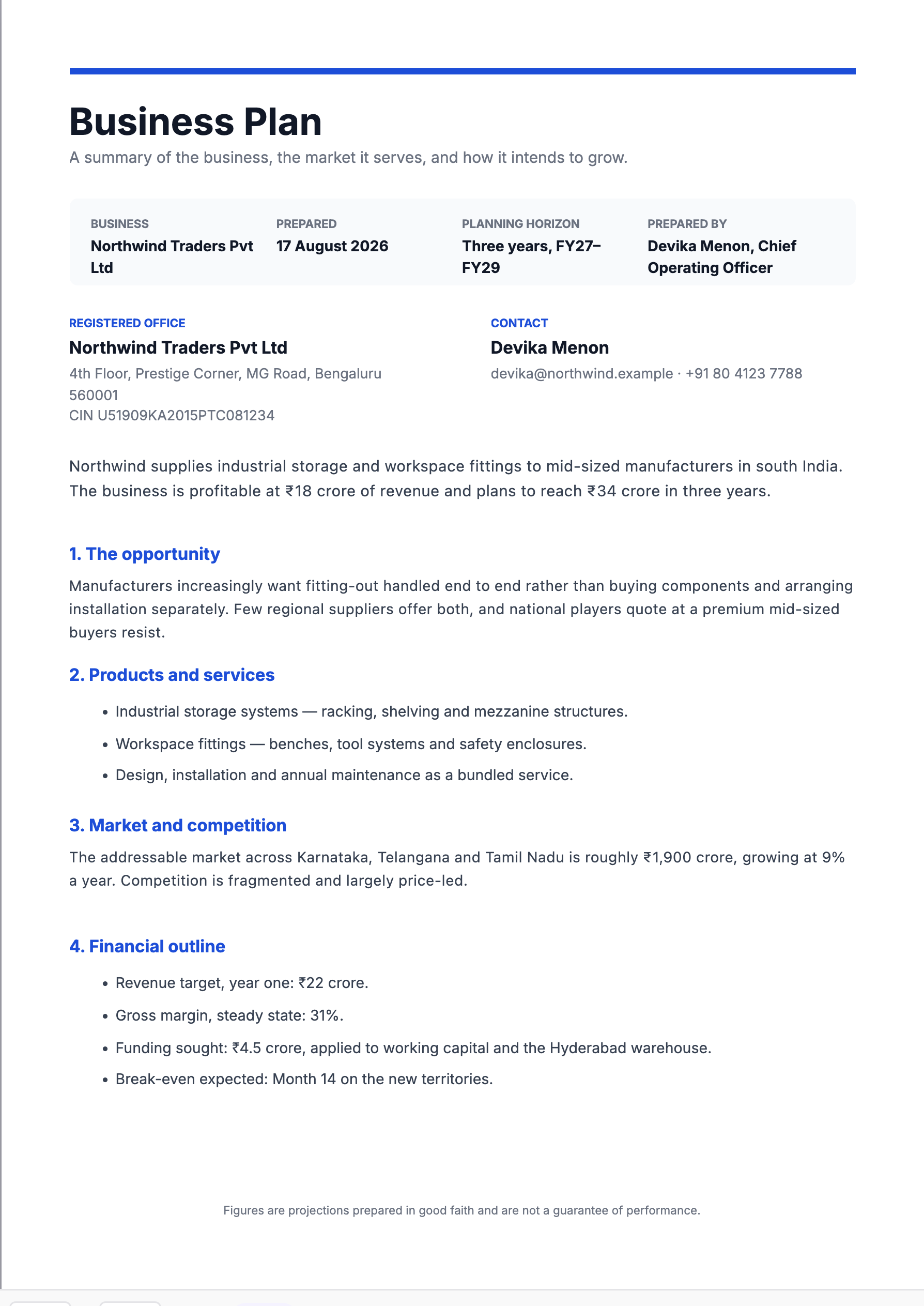
A business plan is written for someone who is about to decide something — whether to lend, to invest, to join, or to sign off next year's budget. Everything in it earns its place by helping that decision, which is why one page that answers the real questions beats thirty that circle them.
What the reader is actually checking
| Section | What they are looking for |
|---|---|
| Executive summary | Whether the rest is worth reading. |
| The opportunity | A specific gap, not a market in general. |
| Products and services | What you sell, plainly enough to price. |
| Market and competition | The size, the growth rate, and who else is already there. |
| Financial outline | Revenue, margin, funding, break-even — and whether they agree. |
| Planning horizon | Which years these numbers describe. |
| Prepared by and date | Who owns the assumptions, and how fresh they are. |
The summary is the document
Most readers read the executive summary and skim the rest. In roughly forty words it has to say what the business does, who it does it for, where it stands now, and where it is going.
The credibility comes from the present tense. "Profitable at ₹18 crore of revenue and plans to reach ₹34 crore in three years" works because the first half is a checkable fact and the second half is anchored to it. A summary made entirely of ambition — the ₹34 crore with no ₹18 crore behind it — reads as a forecast by someone with nothing to forecast from.
Market size is not an achievement
A ₹1,900 crore addressable market growing at 9% a year tells a reader almost nothing on its own. The number they will work out for themselves is your share of it: ₹22 crore of ₹1,900 crore is a little over one per cent. State it yourself. Quoting a large market and never dividing asks the reader to do the arithmetic that makes you look reasonable, and they will do it less charitably than you would.
Be specific about competitors, and honest. "Fragmented and largely price-led" is genuine information — it says how you intend to win and admits where the margin pressure comes from. A plan claiming no competitors reads as a plan by someone who has not looked.
The four numbers have to agree with each other
Revenue target, gross margin, funding sought, break-even. Each is easy to write on its own; they are only credible together.
₹4.5 crore of funding against ₹22 crore of first-year revenue at 31% gross margin, breaking even in month 14 — the first thing an experienced lender does is check whether the funding actually covers those fourteen months. If it covers ten, you have asked for the wrong amount, and every other number is now suspect too.
Split what the money is for. "Working capital and the Hyderabad warehouse" is two different risks in one line: working capital recycles, a warehouse fit-out does not. Lenders price and secure them differently and will ask for the split anyway, so give it to them.
Date it, version it, and say who wrote it
The planning horizon and the preparation date are the two fields most often left stale. A plan headed FY27–FY29 carrying figures assembled eighteen months ago is worse than no plan at all, because the reader cannot tell which parts you still believe. Re-issue with a new date rather than editing the old file in place, so two people discussing "the plan" can establish they mean the same one.
Name the author and their role. Someone will have a question about the margin assumption, and a plan nobody signed suggests nobody owns the numbers.
Keep the note that projections are projections. It costs nothing and it is true. What it does not cover is a figure you knew was optimistic when you typed it — that one gets remembered.