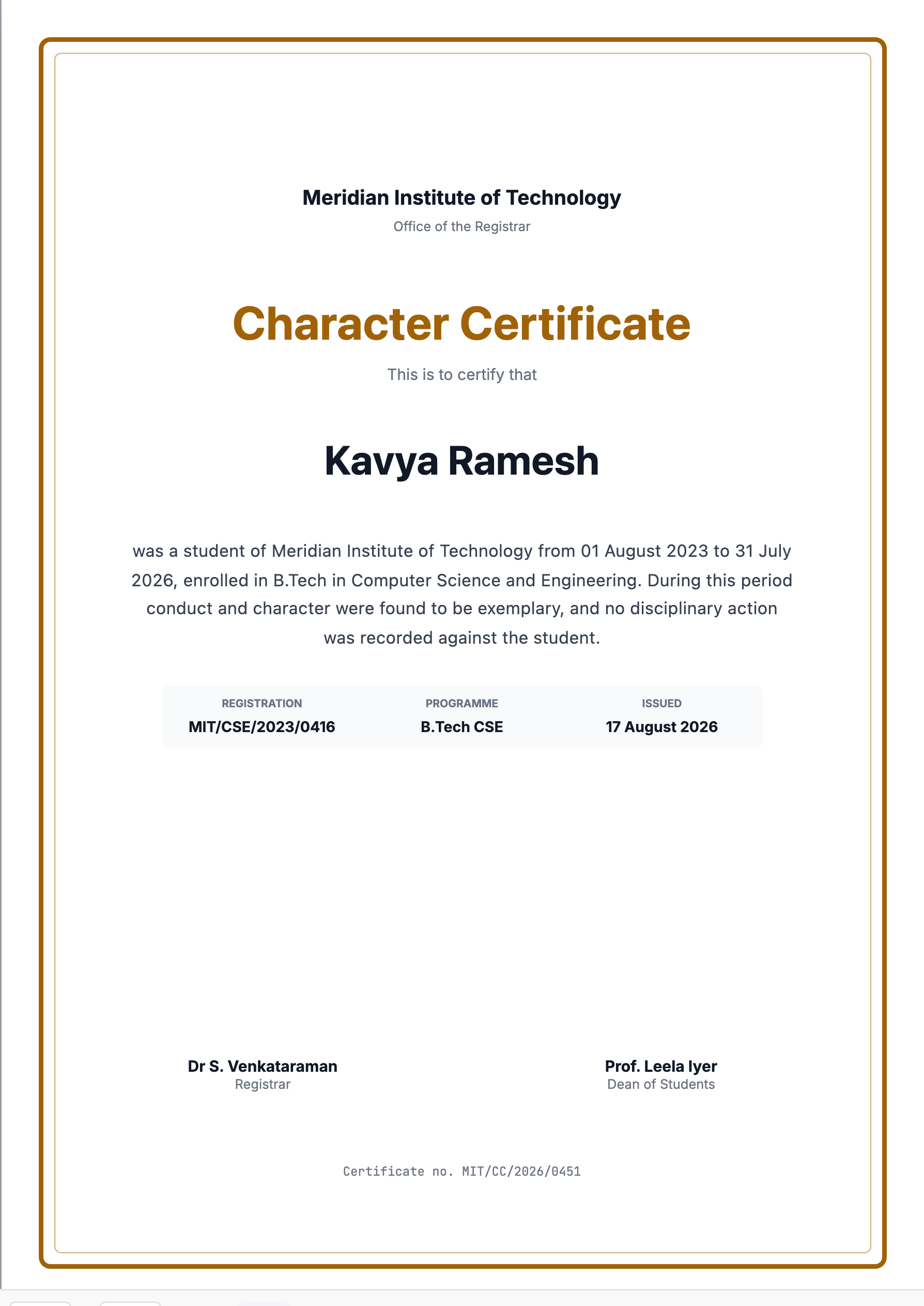
A character certificate is the one document in the set where an institution offers an opinion rather than a record. Police verification, government recruitment, professional registration and several visa categories ask for it, and each of them reads it as the institution putting its name to a claim about a person.
The period is the certificate
The sentence that carries the weight is from 01 August 2023 to 31 July 2026. Everything the institution is asserting sits inside that window, and nothing outside it.
Leave the dates vague and the claim becomes unbounded — the reader takes the certificate as vouching for the person today, which the institution has no way of knowing. A student who left four years ago may have done anything since. Two dates and a registration number turn a testimonial into a bounded statement of what your records show.
This is also why the layout is a certificate rather than a letter. There is no addressee. It is meant to be handed to the student and shown to whoever asks next, so it must read correctly to someone you have never heard of.
The checkable fact beats the adjective
The template carries both a character word — exemplary in the sample — and the line that no disciplinary action was recorded. The second is doing the real work.
"Exemplary" is a judgement, and a stranger cannot weigh it. "No disciplinary action was recorded against the student" is a fact drawn from a register, and it is exactly what a verifying officer is trying to establish. Keep it, and keep it literal: it says nothing was recorded, not that nothing happened.
Be aware that the adjective is comparative even when you do not intend it to be. If your office writes "excellent" by default, "good" lands as a signal. Pick one word your institution uses consistently and reserve variation for cases where you mean it.
Check the record before you sign
The failure mode here is procedural rather than editorial. Character certificates are requested at a counter, often in a queue, often on the day the student needs them, and the temptation is to issue against the request rather than against the file.
Someone has to look at the disciplinary register and confirm there is no pending proceeding. An institution that skips this eventually issues a clean certificate to a student with an open case, and then has to explain why its own records contradict its own signature.
Two signatories, not one
The template has space for the registrar and the dean of students, and that pairing is deliberate. One office holds the record; the other holds the judgement about conduct. A certificate signed by both is harder to obtain improperly from inside the institution, and it gives a verifier two places to write to rather than one.
Print each signatory's office beneath the name. A verifier who cannot tell whether a signature belongs to someone with authority to give it treats the certificate as unverified.
Number it and keep the counterfoil
Certificate numbers here work as they do on any issued document: sequential within the year, in a shape like MIT/CC/2026/0451, recorded against the student and the date.
Character certificates attract forgery more than most academic documents, because the claim is valuable and the format is easy to imitate. The register is the only defence. Without it your office cannot confirm a genuine certificate, and — the part institutions notice too late — cannot deny a fake one either.