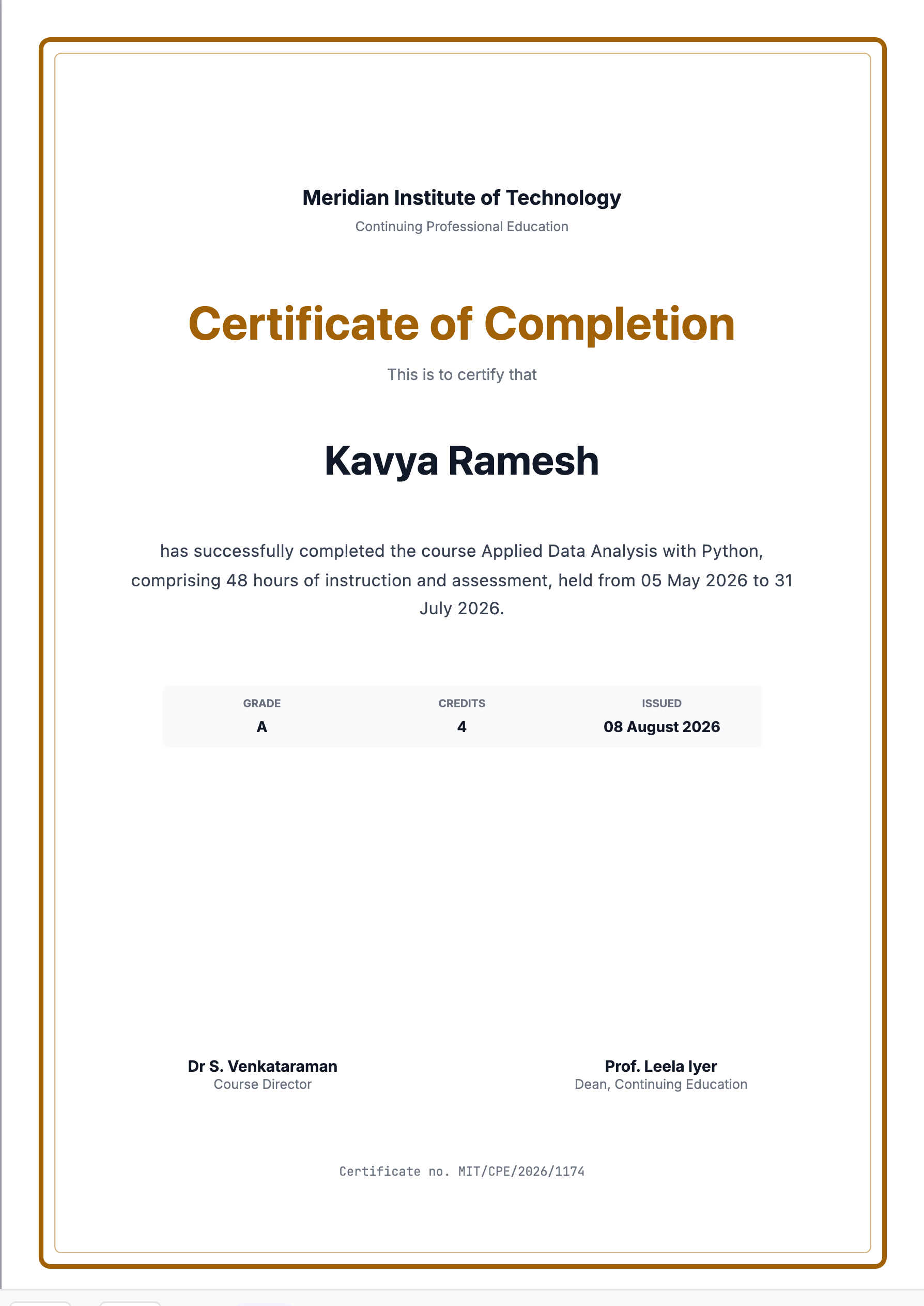
A course certificate is a small claim about a person, issued by an institution, that a third party is expected to trust. The design job is to make that claim specific enough to be worth something.
Certificates that say only "has successfully completed our course" are common and nearly worthless to the person holding one. This template asks for the details that make it useful.
What makes a certificate verifiable
| Field | Why it matters |
|---|---|
| Full name | As the recipient uses it professionally. |
| Exact course title | The one that appears in the syllabus. |
| Duration in hours | Lets an employer judge depth. "A course" does not. |
| Dates | When it ran, not when the certificate was printed. |
| Grade or result | If assessed. Say so if it was not. |
| Credits | Where the course carries academic credit. |
| Certificate number | The reference for any verification request. |
| Signatories | Named, with their roles. |
The certificate number is the most useful field on the page
It is also the one most often left off. Without it, someone verifying the certificate has to describe the person and the course over email and hope your office can find them.
Use a scheme that encodes something: institution code, programme, year,
sequence. MIT/CPE/2026/1174 is greppable and tells you where to look before
you look. Keep the register that maps numbers to records — a certificate number
that leads nowhere is worse than none, because it implies a verification process
that does not exist.
Say what "completed" means
Completion can mean attendance, passing an assessment, or submitting a project. An employer reading the certificate cannot tell which.
The body text on this template names the hours of instruction and assessment, which distinguishes it from an attendance certificate. If your course is not assessed, say "attended" rather than "successfully completed" — it is honest, and it protects the value of the certificates you issue for courses that are.
Two signatories, and why
Convention is a course director and a dean, or an instructor and a head of department. The point is not ceremony: it is that two named people with stated roles is harder to forge convincingly than one illegible signature, and it tells a verifier who to contact.
Use real names and real titles. "Authorised Signatory" identifies nobody.
On design
Certificates get printed, framed and photographed. A few things follow.
Keep the recipient's name large and unambiguous — it is the reason the document exists. Leave generous margins, because frames eat 8–10mm on every edge. Avoid pale text on white; it photographs badly and photocopies worse.
This template is portrait A4 with a double border. If you are printing on pre-printed certificate stock, delete the border layers rather than trying to align to them.
Issuing at scale
A cohort of two hundred means two hundred certificates that differ only in name, grade and number. That is exactly the case for generating from a list rather than editing a file per student — and it removes the copy-paste error where two people receive the same certificate number.