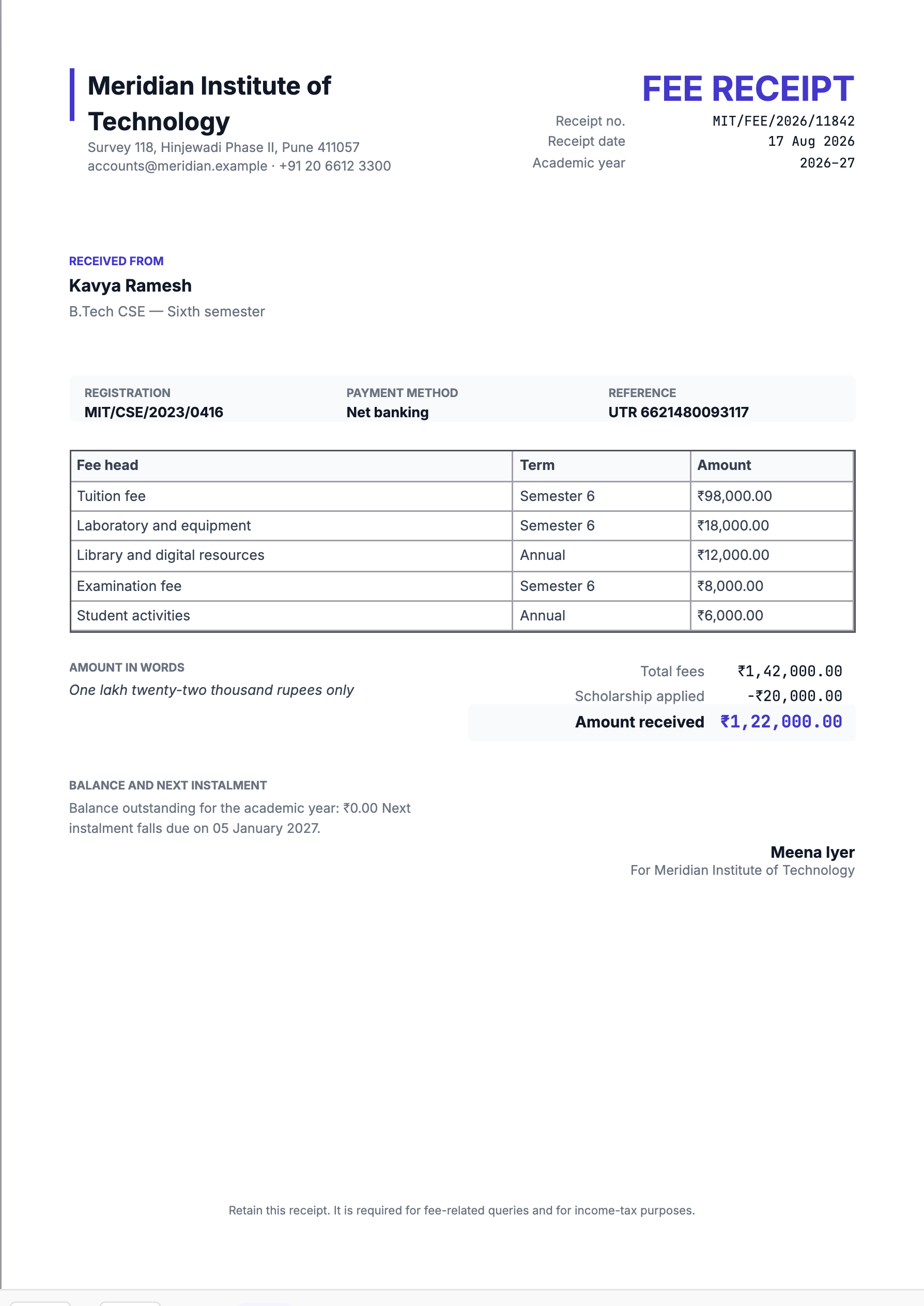
A fee receipt is the document a family keeps. Long after the semester ends it is what proves the money was paid, what it was paid for, and — when a refund, a renewal or a reimbursement claim comes up — how much of it was tuition.
What belongs on a fee receipt
| Field | Why |
|---|---|
| Receipt number | Unique, so a payment can be cited without attaching the document. |
| Receipt date | When the receipt was issued. |
| Academic year | Fees repeat every year; the year is what separates them. |
| Student name | Who studies — not necessarily who paid. |
| Registration number | The identifier the ledger is keyed on. |
| Programme and semester | Which stage of the course this covers. |
| Fee head, term, amount | One line per head, never a single lump sum. |
| Concession or scholarship | Shown as its own deduction line. |
| Amount received | In figures, and in words for larger sums. |
| Method and reference | Net banking UTR, cheque number, card approval code. |
| Balance and next instalment | What remains, and when the next one falls due. |
One line per fee head, with the term against it
A receipt reading "Semester fees ₹1,22,000" is arithmetically complete and practically useless. Split it — tuition, laboratory and equipment, library, examination, student activities — because almost everything done with this receipt afterwards needs the split. Refunds on withdrawal are computed head by head, and an employer reimbursing a course usually reimburses tuition and little else. Both send somebody back to the accounts office for a breakdown you could have printed the first time.
The term column carries as much weight as the amount. "Library and digital resources ₹12,000" is ambiguous; "₹12,000 — Annual" says plainly that it will not appear again in January. That ambiguity does not stay theoretical — it turns into a phone call at the next instalment.
Show the concession, do not net it off
If a student is billed ₹1,42,000 and pays ₹1,22,000 under a ₹20,000 scholarship, the receipt should show all three numbers. Printing the ₹1,22,000 alone loses the award completely.
Two things break when it disappears. The scholarship register and the fee ledger stop reconciling, and nobody notices until an audit forces the comparison. And the student holds a receipt that does not evidence the concession — which matters when they apply to renew it, or when whoever funds the award asks for proof it reached them. Show it as a negative line under the fee heads, so the arithmetic reads straight down: total fees, concession, amount received.
The registration number is what the receipt joins on
Names are not unique. Any cohort of reasonable size holds two students with the same name and a third whose name is spelled two ways across your own records. The registration number survives all of it — it is what the fee ledger, the examination roll and the scholarship register are keyed on.
The payment reference does the same job on the bank side: a UTR, cheque number or approval code turns "we paid in August" into a specific line in a statement somebody can point at. Take it from the transaction record rather than a parent's screenshot, and take it in full.
Balance, the next instalment, and what this is not
Say the balance out loud even when it is zero. "Balance outstanding for the academic year: ₹0.00" closes a question a silent receipt leaves open, and the person filing this document away is exactly the audience that wants it closed. Printing the next due date beside it is the cheapest reminder an accounts office will ever send, and it lands at the one moment the payer is certainly reading.
Finally, a fee receipt is not a demand note. A demand note asks for money and goes out before payment; a receipt confirms money arrived and goes out after. They carry different numbers, different dates and different consequences — and a demand note stamped "PAID" is neither of them.