Most business is done by email, which is exactly why the things still sent as letters are the ones that matter — notices, renewals, escalations, anything that may be produced later as evidence of what was said and when.
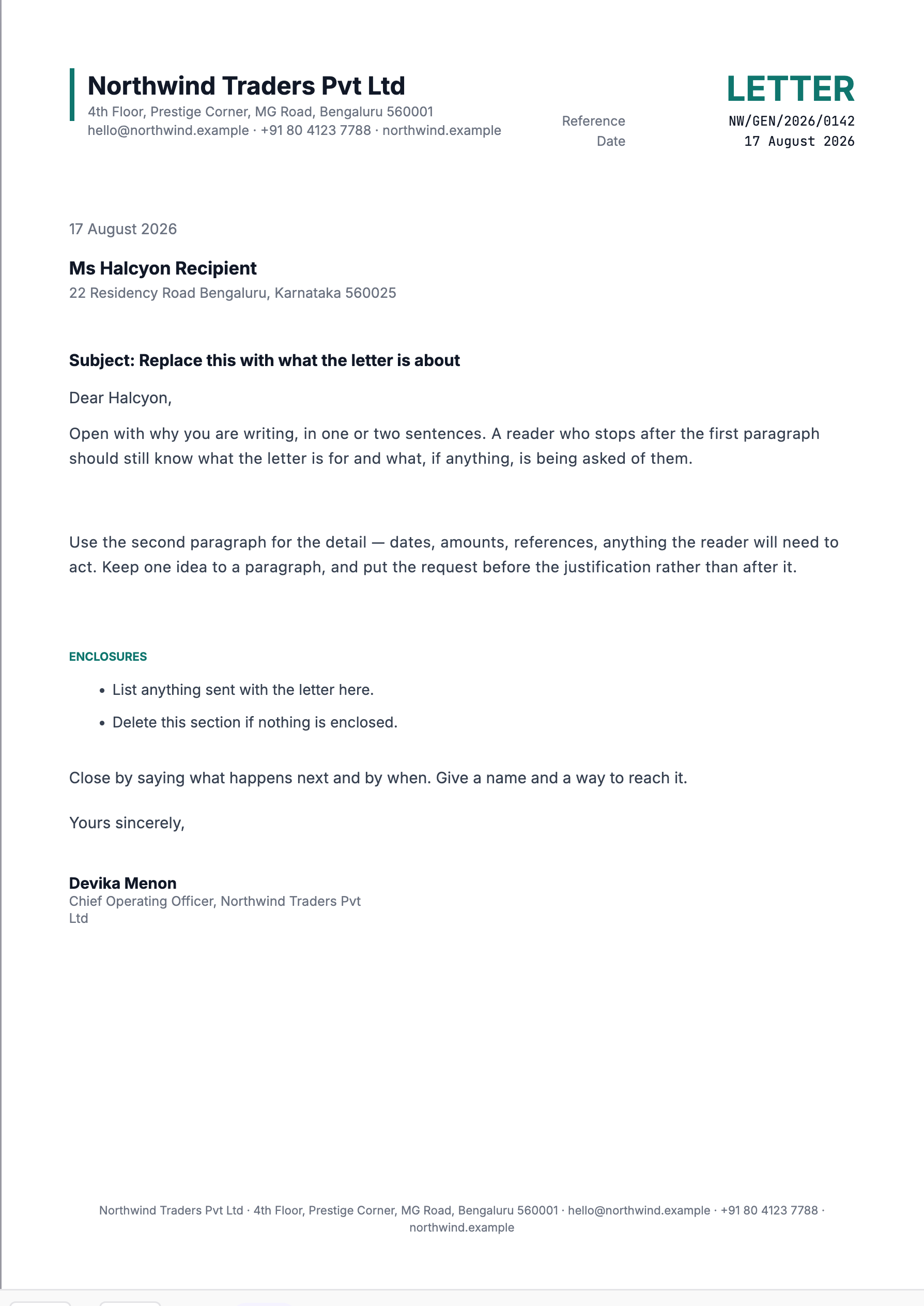
This template is a letterhead and the letter that sits on it: the masthead, the reference and date block, the recipient, the subject line, the body, the enclosures and the signature.
The reference number is not decoration
NW/GEN/2026/0142 — originator, class, year, serial. The scheme matters less
than the fact that there is one and that somebody records it. A reference exists
so that a reply can be filed against the letter it answers, and so that "our
letter of 17 August" can be found later without reading a whole folder.
Two habits make it work. Issue references from one place, so two departments cannot mint the same number. And when replying to a letter that carries its own reference, quote theirs as well as yours — the person filing your reply is looking for their number, not yours.
Subject lines and opening paragraphs do different jobs
The subject line is read by whoever decides where the letter goes. It should say what the letter concerns and, if there is a deadline, name it: "Renewal of warehouse lease, Hosur Road — response required by 30 September". "Regarding our recent discussion" routes to nobody.
The opening paragraph is read by the person it lands on. A reader who stops after it should still know why you are writing and what, if anything, is being asked of them. That means the request goes before the justification — the reverse order reads as building a case, and people who feel a case being built stop reading and forward it on.
Keep one idea to a paragraph. The body is where dates, amounts and references belong, in the order the reader will need to act on them.
Sincerely and faithfully are not interchangeable
British convention pairs the sign-off to the salutation, and getting it wrong is the single most visible tell on an otherwise careful letter.
| If the letter opens | It closes |
|---|---|
| Dear Ms Menon / Dear Devika | Yours sincerely |
| Dear Sir, Dear Madam, Dear Sir or Madam | Yours faithfully |
| Dear Sirs (to an organisation) | Yours faithfully |
The rule underneath: if you have named the person, sincerely; if you have not, faithfully. The template ships with a named salutation and "Yours sincerely", so they already agree — if you change one, change the other.
Where you are unsure of a title, use the full name rather than guessing. "Dear Halcyon Recipient" is neutral. A wrong "Mrs" is the only thing the reader will remember about the letter.
The enclosures block is a checklist, not a courtesy
It serves the person opening the envelope, who can count what should be there — and it serves you when the recipient says the annexure never arrived.
Name the documents. "Signed lease renewal, four pages" is checkable; "as discussed" is not. If the enclosure has its own reference — an invoice number, a drawing number — put it in the line.
And if nothing is enclosed, delete the heading and the bullets. An empty "Enclosures" section with placeholder text under it is the most common defect on letters produced from a template, and it tells the reader precisely how much attention the letter received.
Why your details appear at the top and the bottom
That repetition is not an oversight. Letters get separated from envelopes, photocopied, scanned into case files and attached to emails as a single page. The footer is what keeps the letter identifiable once the masthead has been cropped off the top of a scan.
It is also where statutory identifiers go. Many Indian companies must show their corporate identity number and registered office address on business correspondence; check what applies to yours and put it in the footer rather than crowding the masthead. Whatever goes there, change it in one place and let every letter inherit it — a letterhead carrying last year's phone number is worse than none, because someone will dial it.