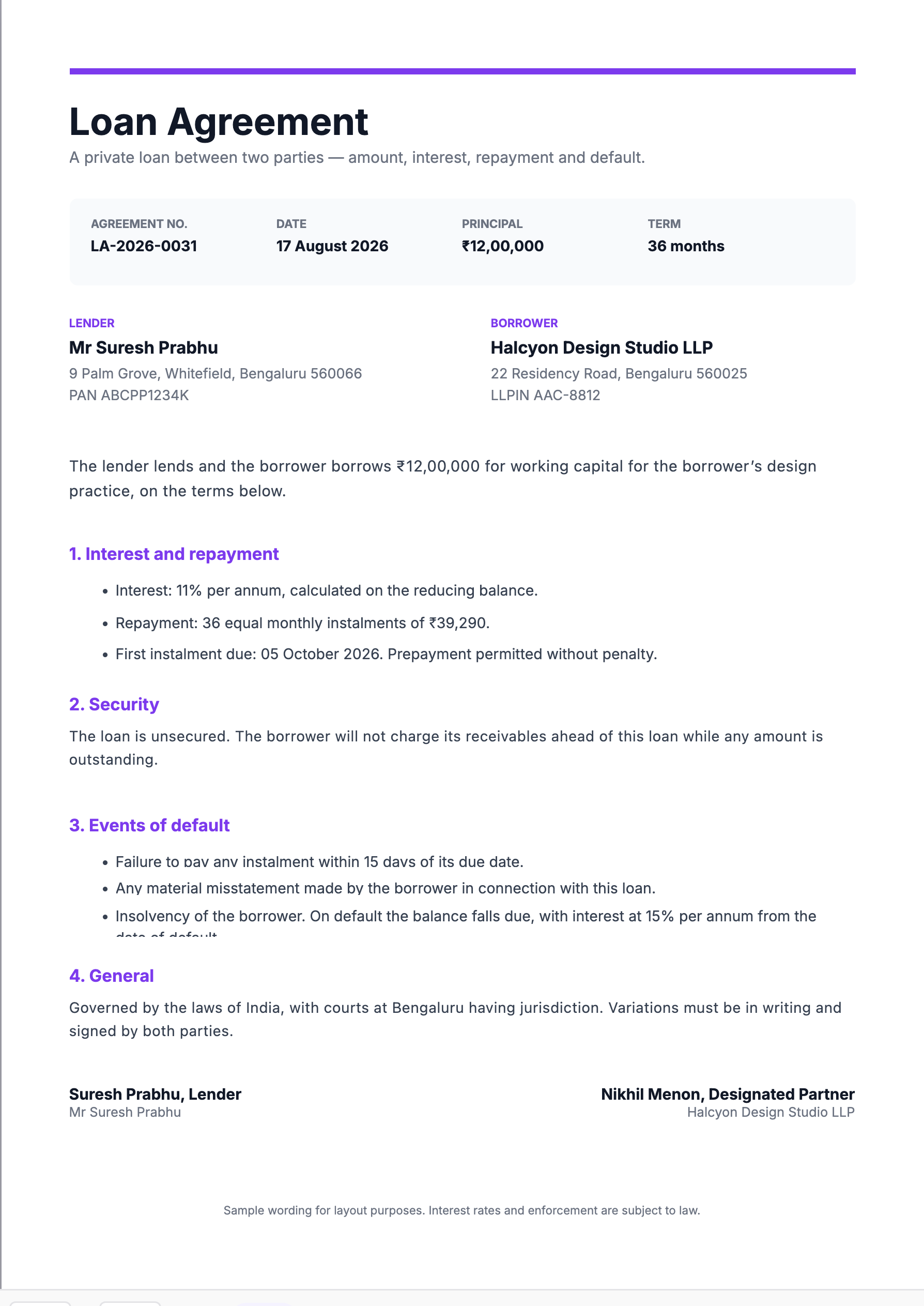
A private loan agreement exists so that two people who currently trust each other do not have to rely on memory in three years' time. The parts that matter most describe what happens when repayment stops — which is precisely the part nobody wants to discuss while the money is being handed over.
What a loan agreement records
| Field | Why |
|---|---|
| Principal | The amount actually advanced. |
| Purpose | What the money is for. |
| Interest rate | And the basis it is calculated on. |
| Repayment | Number, size and frequency of instalments. |
| First due date | When the schedule starts running. |
| Grace period | How late an instalment can be before it counts as default. |
| Default interest | The rate that applies once default has occurred. |
| Security | What backs the loan, or a statement that nothing does. |
| Governing law | Which law applies, and which courts hear a dispute. |
| Signatures | Both parties, with PAN, CIN or LLPIN. |
Flat or reducing changes the number more than the rate does
The sample says "11% per annum, calculated on the reducing balance", and that phrase is worth more than the rate in front of it. On a reducing balance, interest each month is charged only on what is still outstanding, so ₹12,00,000 over 36 months works out at instalments of roughly ₹39,290. The same 11% quoted flat — interest charged on the full original principal for the whole term — lands nearer ₹44,300 a month, about ₹1.8 lakh more across the loan for an identical headline rate.
Write both the basis and the instalment figure. They check each other: if either side recalculates later and gets a different number, the disagreement surfaces immediately instead of in year three. Do the same with prepayment. The sample permits it without penalty, which is a genuine concession to the borrower and should be stated rather than assumed.
Unsecured is a choice, and a negative pledge is not security
The sample loan is unsecured and says so in a sentence rather than omitting the subject. That is the right instinct — silence about security reads as an oversight, and oversights are what people argue over.
Attached to it is a negative pledge: the borrower will not charge its receivables ahead of this loan while any amount is outstanding. Be clear about what that achieves. It is a promise, not a charge. If the borrower breaks it, the lender has a claim for breach of the agreement; it does not gain priority over whoever actually took security. A negative pledge is useful discipline and weak protection, and confusing the two is how a lender ends up feeling secured when nothing is.
If security is genuinely intended, identify the asset precisely and treat the registration steps as separate work. A loan agreement that refers to security without describing it secures nothing.
Default, grace, and the records that prove the loan
The grace period is what stops a bank holiday or a delayed client payment turning into a formal default. Fifteen days is generous and sensible for a private loan; the point is to have agreed a number rather than to argue about reasonableness afterwards.
Acceleration should be the lender's option, not automatic. "On default the balance falls due" read literally means the whole ₹12,00,000 becomes payable the moment an instalment is sixteen days late — usually not what a lender wants, because it converts a fixable delay into a demand that cannot realistically be met. "The lender may declare the balance immediately due" keeps room to be reasonable without giving anything up.
None of it helps without records. Advance the money by bank transfer and keep the UTR, acknowledge each instalment received, and maintain a running schedule splitting principal from interest. When the loan is repaid, say so in writing and give the borrower a discharge — the absence of one is how a settled loan reappears years later.
The wording here is a starting point
This is a document layout with sample clauses, not advice on your loan. Interest, enforcement and the formalities surrounding private lending vary with the situation and with the state, and they change. Have the version you plan to sign read by someone qualified before the money moves — reviewing a draft is a small job, and unwinding a loan that was documented loosely is not.