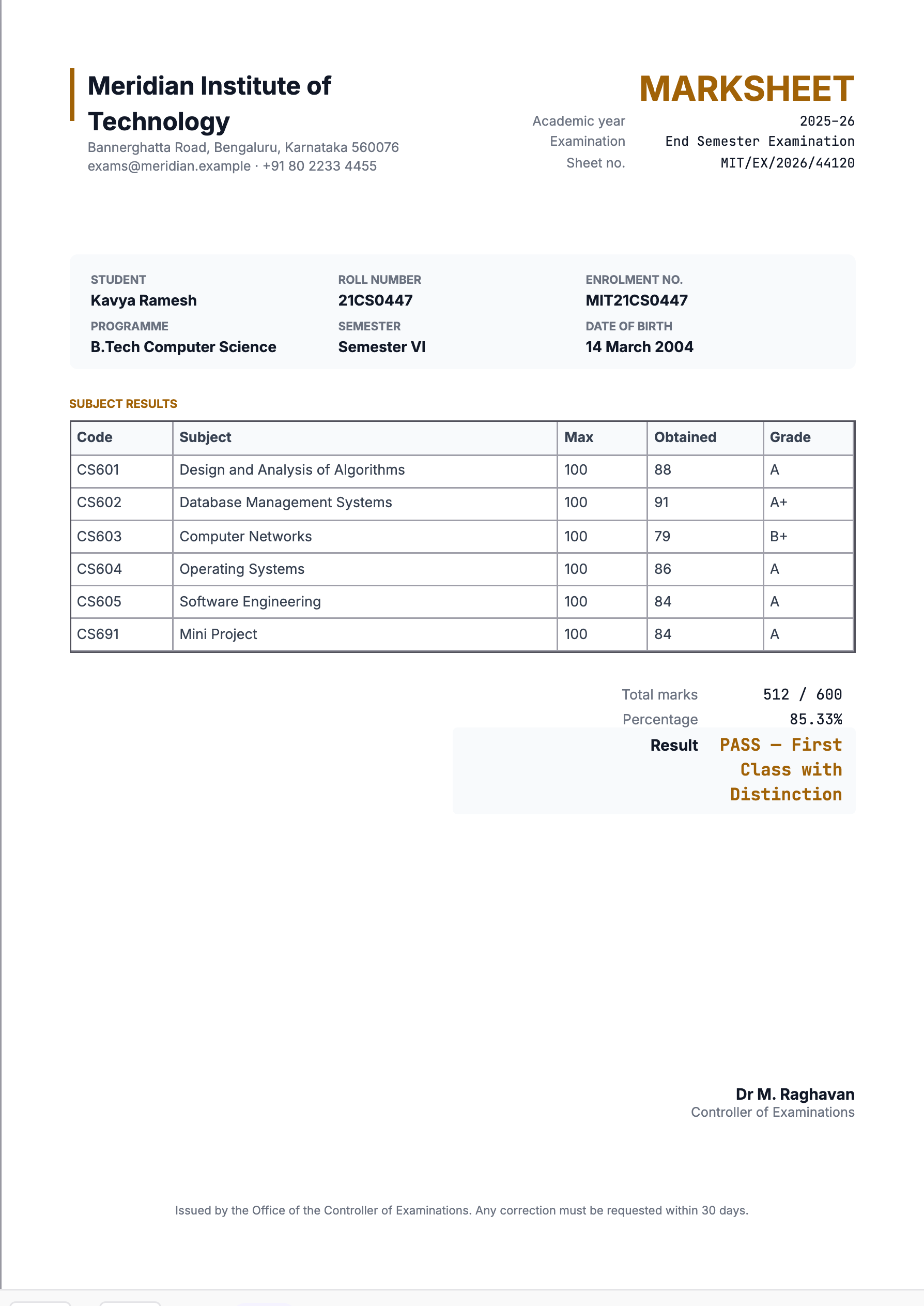
A marksheet is a record that follows a student for decades. It gets submitted for admissions, jobs, visas and professional registrations, often long after the institution's own systems have been replaced twice.
Which makes it worth designing for legibility and verification rather than for fitting on one page at any cost.
Identify the student three ways
Name alone is not enough — names repeat, and transliteration varies. A marksheet should carry:
- Full name, as registered
- Roll number, which is exam-specific
- Enrolment number, which follows the student across their programme
Date of birth is a fourth useful identifier and is what most verification processes actually match on, because it is stable in a way that spellings are not.
The subject table
| Column | Notes |
|---|---|
| Code | The syllabus code. Stable across years; names are not. |
| Subject | The full title, not an abbreviation. |
| Maximum marks | Stated per subject — they are not always equal. |
| Obtained | The awarded marks. |
| Grade | If your scheme uses one. |
Showing maximum marks per row matters more than it looks. A reader who sees only "84" cannot tell whether that is out of 100 or out of 150, and a project or viva component frequently has a different maximum from the theory papers.
Total, percentage and result
Show all three. The total is the raw sum, the percentage is what most external readers compare, and the result line is the institution's own summary judgement — pass, fail, division, distinction.
Note that none of these are calculated by the template. Every figure has to be supplied. That is deliberate for a document of this kind: the authoritative numbers should come from the examination system that computed them, not be recalculated in a layout tool where a rounding rule might differ from the one in your regulations.
Grading schemes need a legend
If you issue letter grades or grade points, the marksheet should explain them — either in a footer legend or on the reverse. A transcript that says "A+" with no scale is ambiguous internationally, where the same letter maps to different bands in different systems.
If you use a relative or normalised scheme, say so. An employer comparing two candidates from different institutions has no way to know otherwise.
Corrections
Mistakes on marksheets are unusually consequential and unusually persistent. The template's footer states a window for requesting corrections, which is worth keeping: it gives students a clear route and gives your examination office a defined period rather than an open-ended obligation.
Never issue a corrected marksheet with the same number as the original. Issue a new number, mark it as superseding, and keep both in the register.
Generating a cohort
Results come out of an examination system as structured data. Marksheets are needed for every student at once, usually under time pressure.
Producing them from that data directly — rather than by editing a file per student — is faster, and it eliminates the transcription step where a mark can change between the system and the document a student receives.