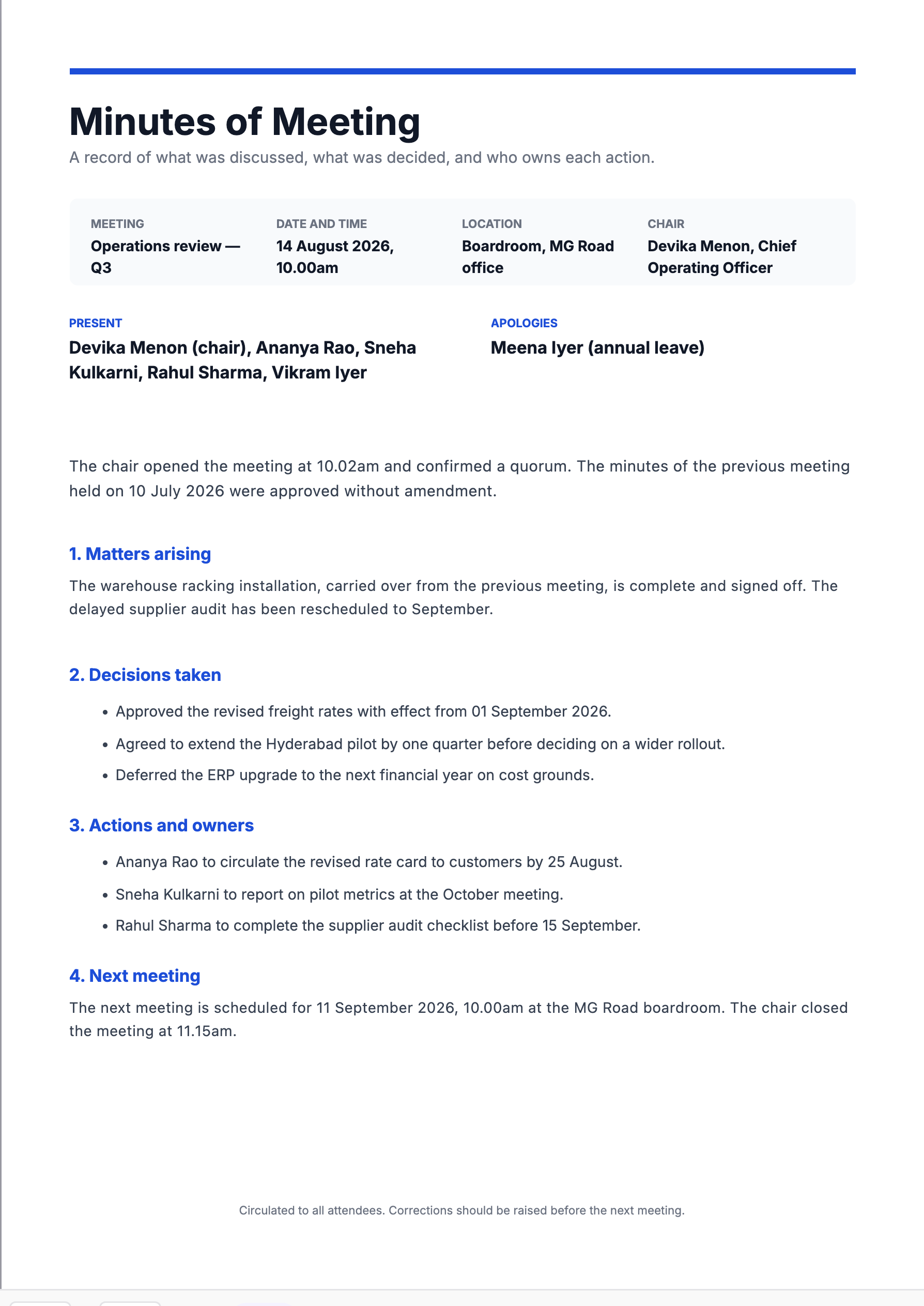
Minutes are read by two kinds of people: someone who missed the meeting, and someone checking six months later whether they really agreed to that. Both want the same two things — what was decided and who is doing what — and neither wants a transcript.
What belongs in a set of minutes
| Field | Why |
|---|---|
| Meeting title | Identifies which meeting, in a series that all look alike. |
| Date and time | The sitting, not the calendar slot it was booked into. |
| Location | Room, office, or the video link. |
| Chair | Who ran it, and whose ruling stands. |
| Present | Who is bound by the decisions — and whether there was a quorum. |
| Apologies | Absent with notice. A different fact from simply absent. |
| Start and end time | The actual span. |
| Matters arising | Items carried forward, and what happened to them. |
| Decisions | Each as a resolution that stands on its own. |
| Actions | Owner, task, deadline. |
| Next meeting | Date and place, fixed while everyone is still in the room. |
Record decisions, not the discussion
The most common failure is two pages of narrative — who said what, in order — with the decision buried somewhere in the middle. Nobody can act on that, and nobody reads it twice.
Write each decision as a resolution: one sentence, past tense, that survives being read alone. "Approved the revised freight rates with effect from 01 September 2026." The effective date is the part that gets left off, and without it a decision is only an opinion — one person implements it on Monday, another waits for the new quarter, and both can point at the minutes.
Minute the deferrals as well. "Deferred the ERP upgrade to the next financial year on cost grounds" is a decision. Leave it out and the item vanishes, then reappears in March as a fresh proposal with the same objections waiting for it.
Every action needs a name and a date
Not a department, not "the team" — a person, a verb and a deadline. "Rahul Sharma to complete the supplier audit checklist before 15 September" is an action. "The audit will be progressed" is a sentence.
Passive voice is how ownership goes missing. It sounds perfectly reasonable in the room, because everyone present knows who is meant, and it is unassignable a month later when they don't. If you cannot name an owner while the meeting is still running, the action has not actually been agreed — say so, and carry it to the next agenda rather than minuting a fiction.
Attendance and apologies are evidence
The present list is not a courtesy. It establishes quorum and it establishes who is bound, and if a decision is ever challenged the minutes are the only record either side has. A board that took a decision three members short will find that out from this list or not at all.
For the same reason, note it against the relevant item when someone arrives late or leaves before a vote. That detail is invisible on every occasion but the one where it settles an argument.
Record the real start time, too. 10.02am is a fact; 10.00am is a booking.
Circulate them while they can still be corrected
Draft minutes sent within a day or two get read properly, because people still remember what they said and will push back on a decision recorded a shade wider than they meant it. Minutes sent the evening before the next meeting get approved unread — at which point the record is whatever the minute-taker remembered, and it is now approved.
Matters arising is what makes the cycle close. Last month's actions come back as this month's first item, with a status against each. An action that never reappears was never really an action; it was a good intention that happened to get written down.