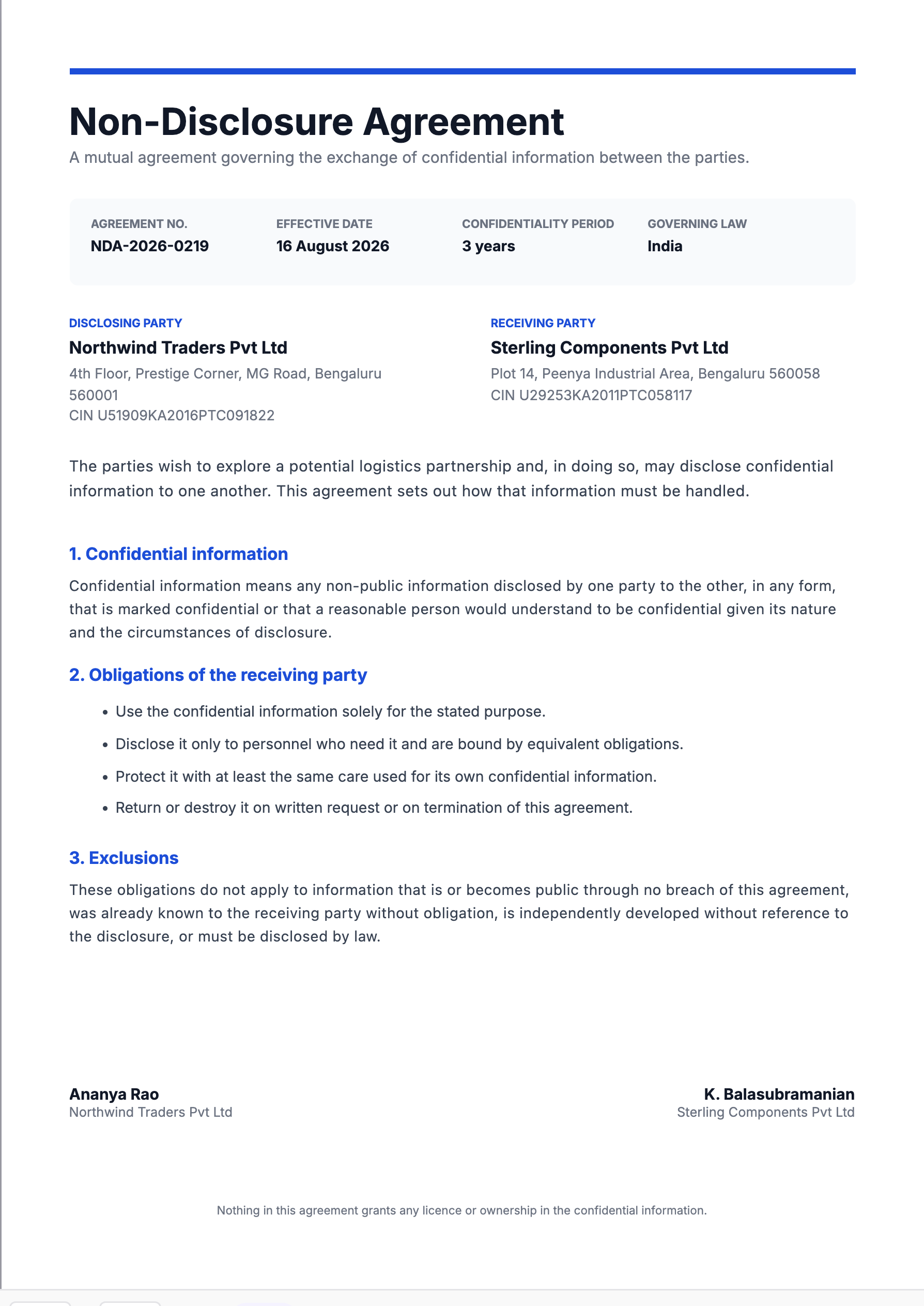
An NDA is usually the first document two organisations sign, before anyone knows whether there is a deal. That gives it a specific character: it should be short enough to sign quickly and precise enough to be worth having.
This template is a mutual NDA — both sides may disclose and both are bound. That is the right default for exploratory conversations, where in practice information flows both ways whatever the paperwork says.
State the purpose
The purpose clause is the most important line in an NDA and the one most often left generic.
It does two things: it limits what the receiving party may use the information for, and it defines the boundary of the relationship. "In connection with evaluating a potential logistics partnership" is a real limit. "For business purposes" is not a limit at all.
Write the actual purpose. It takes a sentence.
Defining confidential information
There are two approaches and both are defensible.
Marking-based: only information explicitly marked confidential is protected. Clean and certain, but it fails in practice, because nobody marks anything in a conversation or a video call.
Reasonable-person: information marked confidential, or which a reasonable person would understand to be confidential given its nature and the circumstances. Broader, and it survives the way people actually work.
This template uses the second. If your counterparty pushes for the first, the practical compromise is to accept marking-based for written material and keep the reasonable-person standard for oral disclosure summarised in writing shortly after.
The obligations that matter
- Use it only for the stated purpose.
- Share it only with people who need it, and who are themselves bound by equivalent obligations.
- Protect it with at least the care used for one's own confidential information.
- Return or destroy it on request or at the end of the agreement.
That last one is worth keeping realistic. Complete destruction is often impossible — backups, email archives, regulatory retention. A clause requiring it absolutely gets breached by everyone the moment it is signed. Better to require return or destruction of active copies, with archival copies permitted but still subject to confidentiality.
The four standard exclusions
Almost every NDA carves out information that:
- Is or becomes public through no breach of the agreement
- Was already known to the receiving party without an obligation
- Is independently developed without reference to the disclosure
- Must be disclosed by law or court order
These are standard, and an NDA without them is unreasonable rather than strong — without exclusion 3 in particular, you may be agreeing not to build something you were already building.
For the legal-compulsion carve-out, it is normal to add that the receiving party gives notice where it lawfully can, so the disclosing party has a chance to object.
Duration
Two different clocks: how long the agreement runs, and how long the obligations last after it ends. They are not the same. A one-year term with a three-year confidentiality period is a common and sensible shape.
Perpetual confidentiality is sometimes appropriate for genuine trade secrets and is usually excessive for a commercial conversation. Counterparties push back on it, which delays signature — which defeats the point of a short document.
This is a starting point
An NDA is a real contract with real consequences. Use this to draft, and have it reviewed before you rely on it — particularly if the information at stake is significant or the counterparty is in a different jurisdiction.