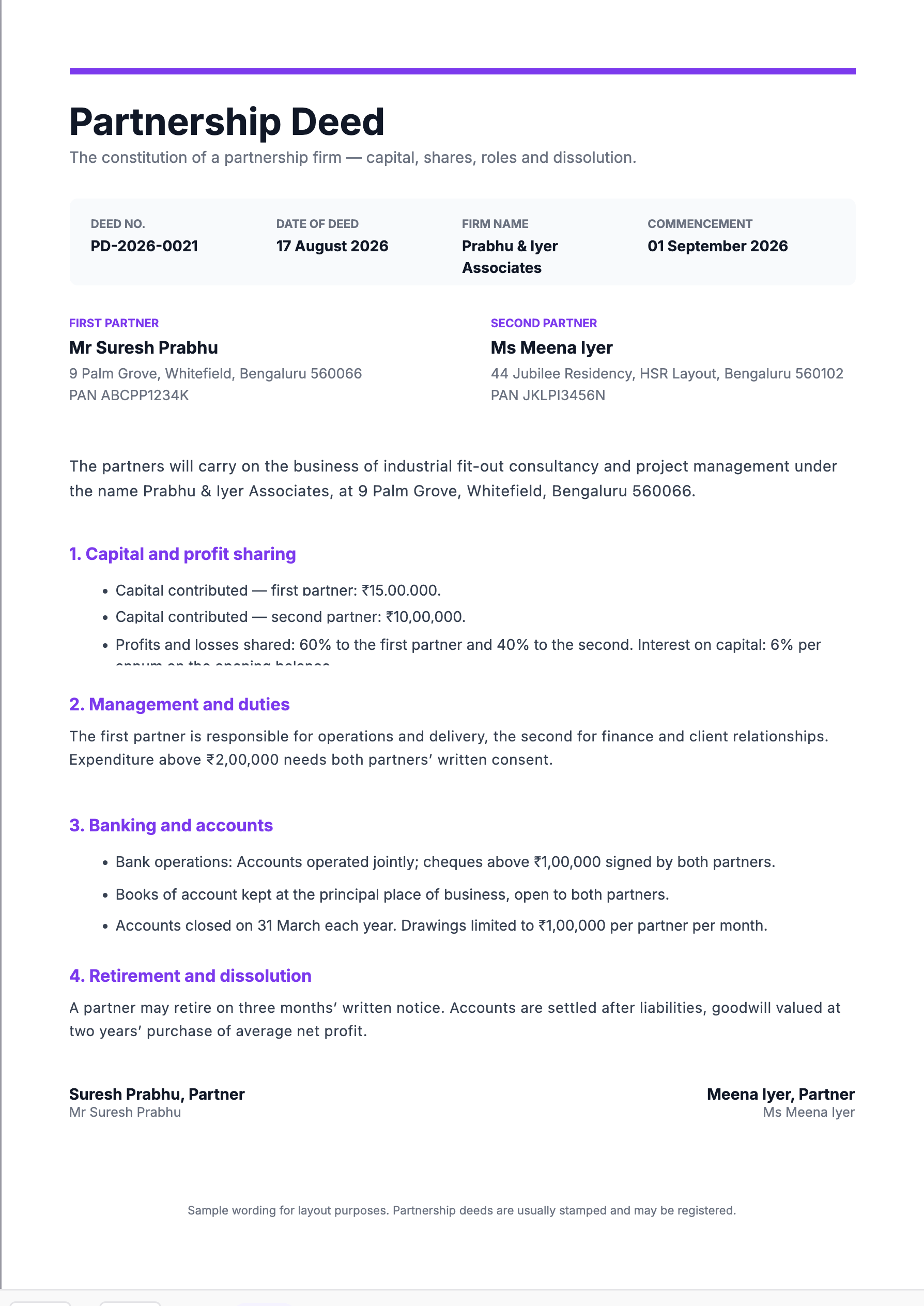
A partnership deed is the firm's constitution: who the partners are, what the business does, who put in what, and how the money gets divided. It is written at the point when everyone gets on, and read at the point when they do not.
What a partnership deed settles
| Clause | What it fixes |
|---|---|
| Firm name | The name the business trades under. |
| Business | What the firm actually does. |
| Commencement | When the partnership starts — often before the deed is signed. |
| Capital | What each partner contributes. |
| Profit share | The ratio, and whether losses follow it. |
| Interest on capital | Whether capital earns a return before profits are split. |
| Drawings | How much each partner may take, and how often. |
| Management | Who decides what, and above what value both must agree. |
| Banking | Who operates the account and which cheques need two signatures. |
| Year end | The date accounts are drawn to. |
| Retirement | Notice required, and how goodwill is valued on the way out. |
Capital and profit share are separate decisions
Capital of ₹15,00,000 and ₹10,00,000 against a 60:40 profit split looks tidy because the numbers happen to line up. They do not have to. Capital reflects what was put in; the profit share reflects what each partner is expected to bring going forward — time, clients, licences, exposure to risk.
Interest on capital is the mechanism that keeps the two honest. At 6% a year on the opening balance, the partner who funded more of the firm is compensated for the money itself before profits are divided in whatever ratio was agreed. Leave it out and the partner who contributed less capital is quietly being paid a return on the other's cash.
Two things the deed should state and frequently does not: whether losses are shared in the same ratio as profits, and what happens if a partner introduces further capital mid-year. Both are obvious in the good years and contested in the bad one.
Drawings, banking and the authority threshold
Drawings of ₹1,00,000 a month are an advance against profit, not salary, and the deed should say plainly that they are adjusted at year end. Partners who treat drawings as pay discover in a lean year that they owe the firm money, and they are never pleased about it.
The banking clause is where the deed becomes operational. "Cheques above ₹1,00,000 signed by both partners" and "expenditure above ₹2,00,000 needs both partners' written consent" are the two thresholds that matter, and they should be set against the firm's real payment pattern. Too low and neither partner can pay a routine vendor without chasing the other; too high and the control is decorative. Look at last year's payments, pick a figure that catches the top few per cent, and revisit it as the firm grows.
Then give the bank the same thresholds. A deed requiring two signatures while the mandate at the branch allows one has restricted nothing.
Retirement, goodwill and the exit nobody plans for
"Two years' purchase of average net profit" is a common goodwill formula and an incomplete one. Average of which years? Net profit before or after partners' remuneration and interest on capital? Taken from the firm's own books or from audited accounts? Three missing words here turn into a valuation argument at exactly the moment the partners have stopped speaking.
The deed should also handle the exits nobody has in mind on day one — death, permanent incapacity, expulsion for cause. Say whether the firm continues with the remaining partner and the outgoing share is paid out over a stated period, or whether it dissolves. In the absence of anything written, the assumption each partner is carrying is usually the one that suits them.
Stamping, registration and getting it read
Partnership deeds are usually executed on stamp paper and may be registered; what that involves varies by state. Expect to be asked for the executed deed more often than you think — the firm's bank, its tax registration and any GST application will each want a copy, so keep signed originals with both partners rather than one.
The wording in this template is a frame for drafting, not a finished deed. Practice and requirements vary by state and by what the firm does. Have the version you intend to sign read by someone who does this regularly, particularly the profit-sharing, goodwill and dissolution clauses.