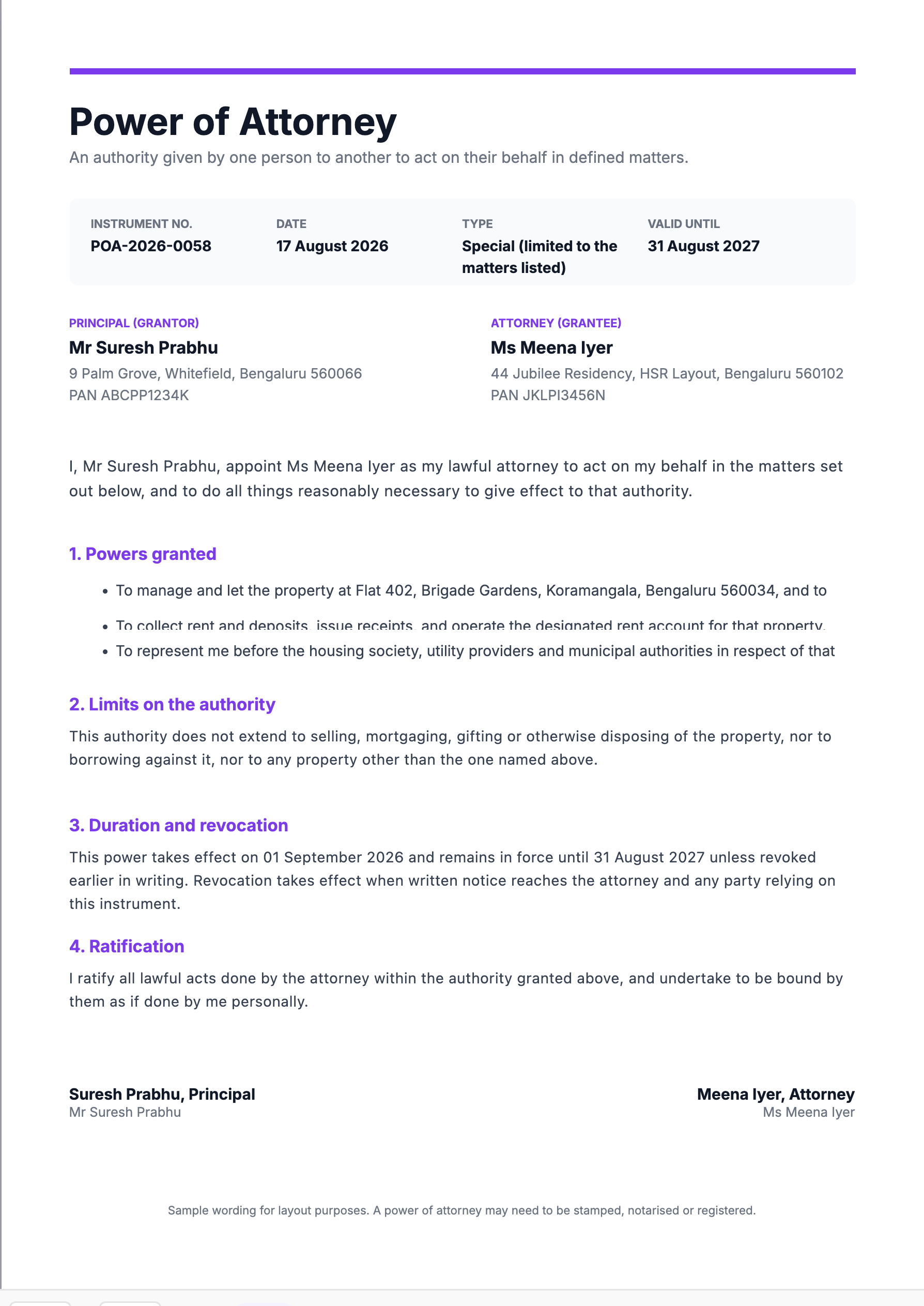
A power of attorney is read by strangers. The people who decide whether it works are a bank officer, a housing society secretary or a registrar's clerk, none of whom know you — and each of whom will do exactly what the document says and nothing it does not.
What the instrument sets out
| Field | Why |
|---|---|
| Instrument number and date | So a specific copy can be identified. |
| Type | General, or special and limited to listed matters. |
| Principal | Who is granting the authority — name, address, PAN. |
| Attorney | Who may act on it. The person the bank will be looking at. |
| Powers granted | Enumerated, one act per clause. |
| Limits | What the authority explicitly does not extend to. |
| Effective date and expiry | When it starts and when it lapses. |
| Revocation | How it is cancelled, and when the cancellation bites. |
| Ratification | That the principal will stand behind acts within the authority. |
Special, and specific about what is special
A general power hands over everything; a special one is confined to the matters listed. For a single purpose — letting a flat while you are abroad, running one account — the special form is almost always the right choice, and the value sits entirely in how the powers are written.
Write them the way the institution reading them will: name the property in full, name the account, name the act. "To collect rent and deposits, issue receipts, and operate the designated rent account for that property" survives a bank counter. "To manage my affairs" does not, and you will discover this from a phone call at an awkward moment.
The catch-all — to do all things reasonably necessary — belongs after the enumerated powers as a tidying clause. It is not a substitute for listing them.
The limits clause is the point of the document
If the powers are already listed, why say what is excluded? Because an enumerated list read alongside a catch-all can be stretched, and because the limits clause is what you point to when somebody has stretched it.
The sample excludes selling, mortgaging, gifting or otherwise disposing of the property, borrowing against it, and any property other than the one named. Those four exclusions cover most of what goes wrong with a property power of attorney.
It protects the attorney as well. Someone acting in good faith for a relative abroad is very glad, two years later when the rest of the family starts asking questions, to hold a document that states plainly what they were never authorised to do.
Effective date, expiry and revocation are three different clocks
The instrument may be signed in August, take effect in September and lapse the following August. Keep those dates distinct. An open-ended power with no expiry makes institutions nervous and gives you nothing to point at when you want it to stop.
Revocation is the part most often got wrong. Written notice has to reach the attorney and anyone relying on the instrument. Signing a revocation and filing it in your own drawer changes nothing — the bank still holds a copy that looks perfectly valid and will keep honouring it. Write to every institution that has one, keep proof of the notice, and collect the copies back where you can.
The ratification clause exists for the other side. It tells a third party that the principal will stand behind acts done within the authority, which is often what makes them willing to deal with the attorney at all.
The formalities vary, so ask first
This is sample wording for a layout, not an instrument to sign unchanged. Powers of attorney are commonly stamped, notarised, or registered depending on the state, on what the powers cover, and on whether immovable property is involved. One executed outside India generally goes through an additional attestation route before it can be used here.
The practical step is the same as with any document someone else has to accept: ask the bank, society or registrar what they need to see before you print, because many of them keep a preferred form of wording and will not tell you until you arrive with the wrong one.