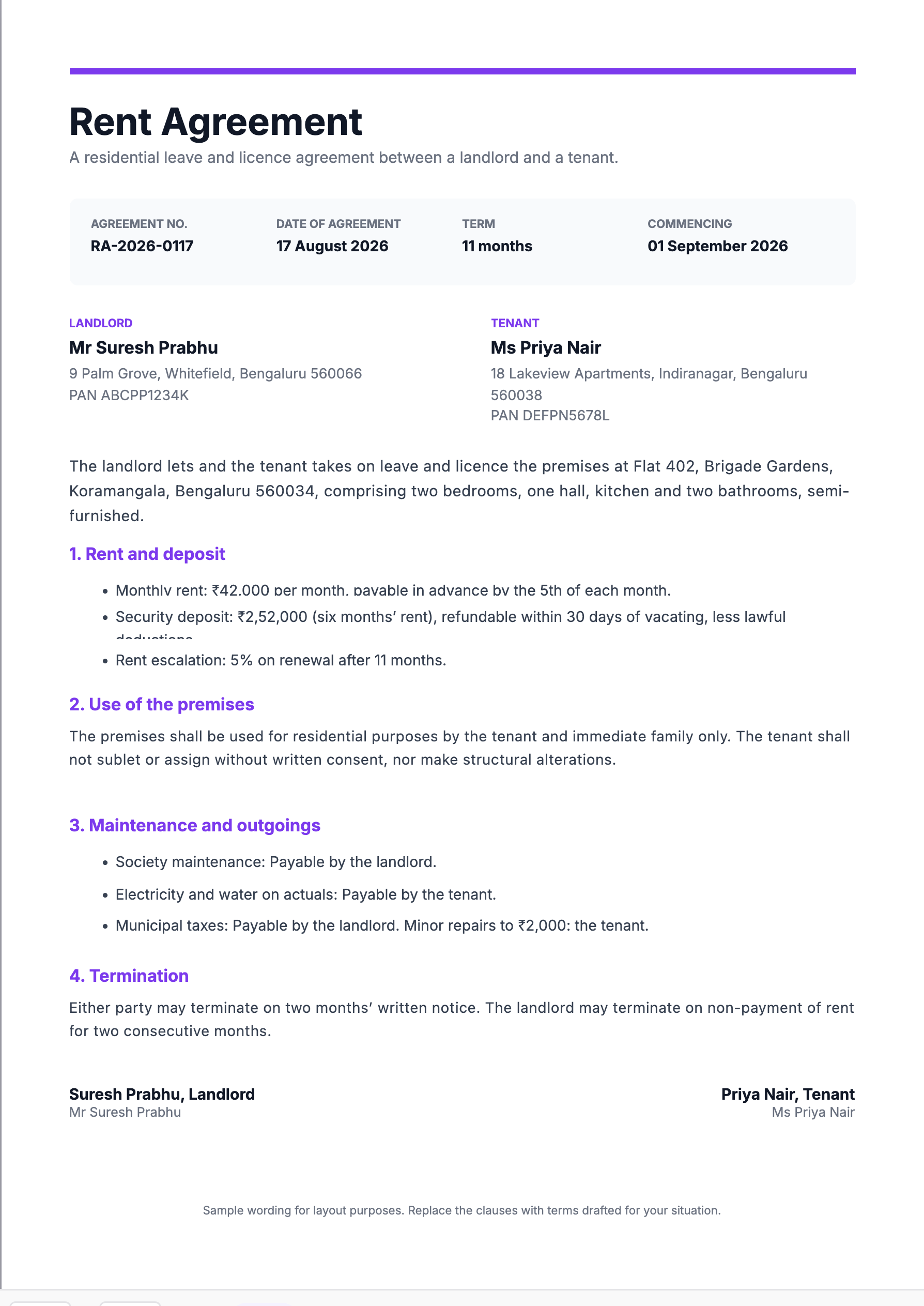
A rent agreement gets read twice: once at signing, when everyone is agreeable, and once when something has gone wrong — a deposit withheld, a tenant leaving in month four. The second reading is the one to write for.
What belongs on a rent agreement
| Field | Why |
|---|---|
| Term and start date | Eleven months from 1 September, not from signing. |
| Landlord and tenant | Full names, addresses and PAN. |
| The premises | Flat, building, locality, and what it comprises. |
| Permitted use | Residential, and by whom. |
| Rent and due day | The amount, and the day it is payable by. |
| Security deposit | The sum, and the refund window. |
| Escalation | What the rent becomes on renewal. |
| Outgoings | Who pays maintenance, utilities and taxes. |
| Notice and default | The ordinary exit, and the one for non-payment. |
Eleven months, and the escalation you agree at the start
Almost every residential agreement in India runs for eleven months. It is a convention, not a rule: formalities attaching to longer tenancies differ by state, so check where the property is before copying the number.
A short term means the tenancy is renegotiated inside a year, which makes escalation matter more than it looks. "5% on renewal after 11 months", agreed at signing, turns month eleven into arithmetic. Left blank, it becomes a negotiation between a landlord who has watched the market move and a tenant who has just paid for curtains.
The notice clause lets either side leave from day one, so a lock-in needs its own line.
The deposit clause is where the arguments start
Deposits vary by city more than any other term — six months' rent, ₹2,52,000 against ₹42,000 a month, is ordinary in Bengaluru and startling in Delhi. What decides whether it comes back quietly is the refund window: "within 30 days of vacating" gives both sides a date.
"Less lawful deductions" is doing quiet work there. Spell out what deductions cover — unpaid rent, unpaid electricity and water, damage beyond fair wear and tear — and the dispute narrows to one mark on one wall.
The rest is evidence. On handover day, photograph the flat, note the meter readings, and have both parties sign the list. Every deposit argument is really about the condition of a place eleven months ago that nobody recorded.
Outgoings, and why the repair threshold matters
Three outgoings, and they do not all go the same way: here the landlord carries society maintenance and municipal taxes, the tenant electricity and water on actuals. "On actuals" means against the bill — name the meter, because a shared connection with no reading is a monthly argument.
The quietly useful field is the repair threshold. Under ₹2,000 the tenant fixes it and moves on; above that, the landlord decides. Without a figure, a dripping tap becomes a week of messages over a ₹400 washer. Structural problems stay with the owner regardless.
How it ends, and what signing does not finish
Notice and default are different exits, kept apart here. Notice is ordinary: two months, either side, no reason needed. Default is breach — rent unpaid for two consecutive months ends the agreement without a notice period. Merge them and a landlord owes two months' notice to a tenant who stopped paying in March.
Signing is rarely the last step. Stamping, and often registration, apply to residential tenancies, and what is expected depends on the state, the rent and the term. Check what applies where the property sits, and treat this wording as a draft rather than a form to sign.