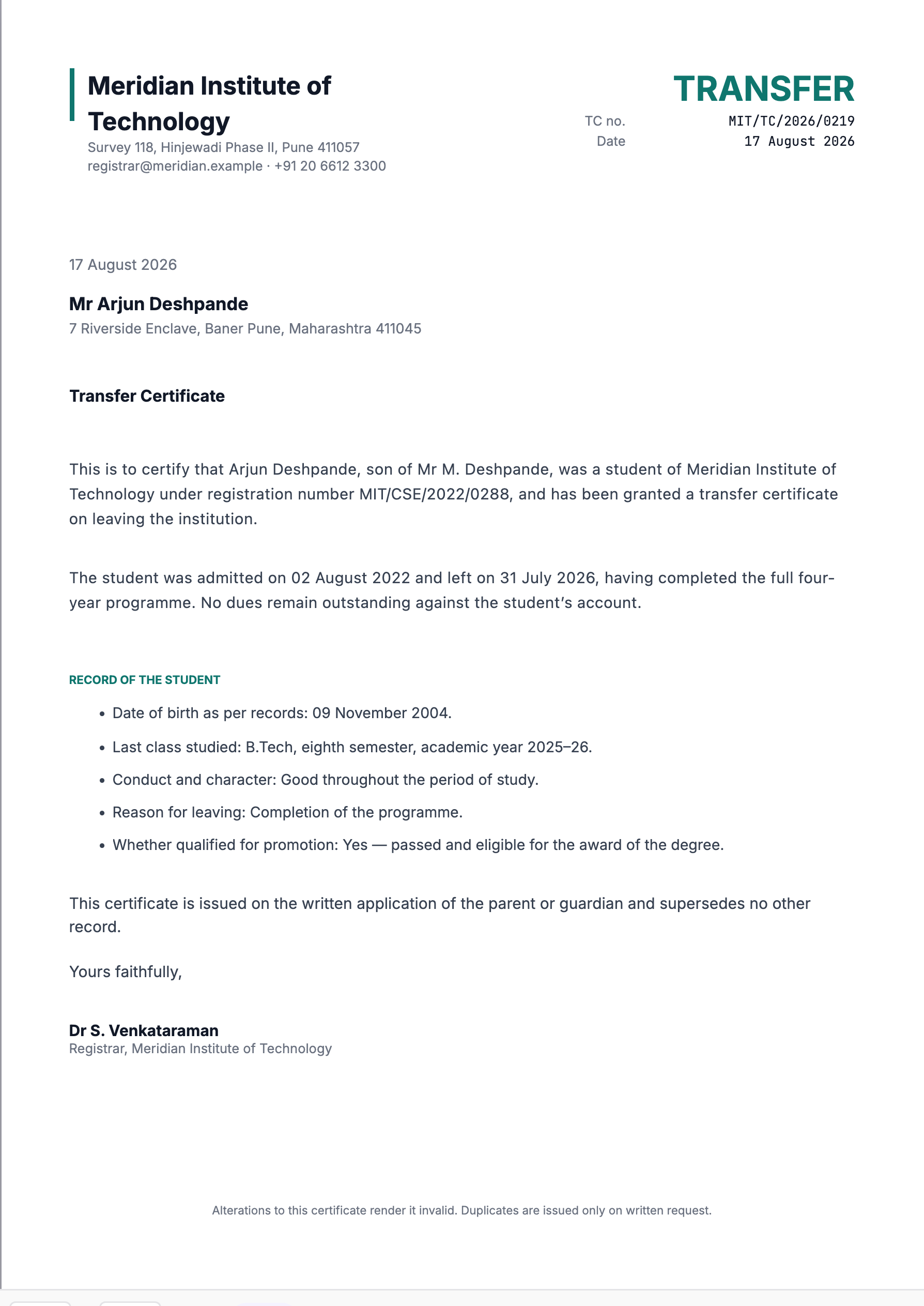
A transfer certificate is a hand-off document between two institutions, not a testimonial for the student. The receiving school reads it to work out which class the student joins and whether anything is outstanding — and until it arrives, most admissions stay provisional.
What a transfer certificate records
| Field | Why |
|---|---|
| TC number | Sequential, and the key to the register entry. |
| Date of issue | Distinct from the leaving date. |
| Student name and guardian | As held in the admission record. |
| Registration number | Identifies the student across your own systems. |
| Date of birth as per records | What the next institution will carry forward. |
| Date of admission | Opens the period this certificate covers. |
| Date of leaving | Closes it, and starts the next school's record. |
| Last class studied | The class completed here, with its academic year. |
| Conduct | A statement you may be asked to stand behind. |
| Reason for leaving | Factual and neutral, not speculative. |
| Qualified for promotion | The single field the receiving school acts on. |
| Dues position | Read as a discharge, so state it accurately. |
The dates define a continuous record
Three dates matter and they are routinely collapsed into one. Admission opens the period, leaving closes it, and issue is simply the day the paperwork was produced — often weeks later, once fees cleared and the register was checked.
The leaving date is the operative one. The receiving institution's record starts the day after, so an error here creates either an overlap or a gap in the student's continuous schooling. Neither surfaces immediately. Both surface years later, when someone reconstructs a timeline for a background check or a visa file and finds the student apparently enrolled in two places at once.
Promotion status is what the next school acts on
Whether qualified for promotion is the line that decides which class the student sits in, and it is the one most often written ambiguously. "Promoted subject to improvement" or "eligible on completion of formalities" gets read optimistically by whoever needs a seat filled.
Write a yes or a no, and name the class or semester the student is qualified to enter. Note that this is different from last class studied — that field records what was completed at your institution, not what comes next.
Conduct and reason for leaving
"Good throughout the period of study" is the ordinary entry, and an ordinary entry is what most TCs should carry. But the vocabulary is comparative in practice: if your office writes "good" as standard, "satisfactory" reads as a warning whether or not you meant one.
An adverse remark on a transfer certificate follows a child for years and is almost impossible to have corrected later. If conduct was genuinely a problem, say something factual and dated, or say nothing — do not reach for a euphemism a stranger will decode uncharitably.
Reason for leaving deserves the same restraint. "Completion of the programme" or "transfer of guardian's employment" is a fact. The family's circumstances are not yours to record.
Originals, duplicates and alterations
A transfer certificate is issued once. The template's footer says alterations render it invalid, which is worth keeping, because an overwritten date is the single commonest reason a receiving school sends one back.
If a student loses theirs, do not print a second original. Issue a marked duplicate on written request, carrying the same TC number with a note of the issue date, and record it in the register beneath the original entry. Two unmarked originals of the same certificate in circulation is how a single leaving date quietly becomes two.