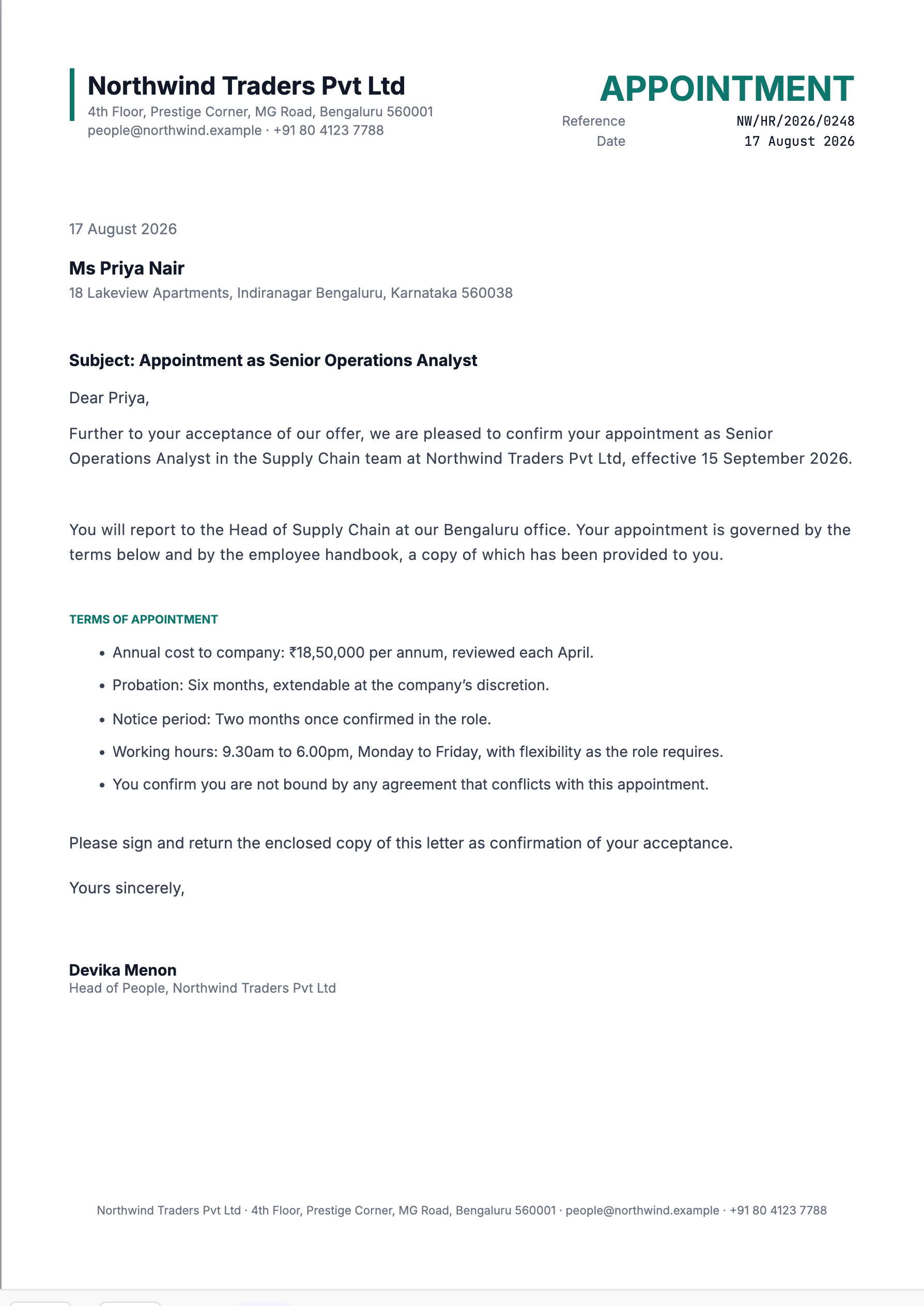
An appointment letter is issued after the candidate has already said yes. That single fact changes what it is for — an offer persuades, an appointment letter records, and it is the record somebody pulls out of the file three years later when a notice period is disputed.
What belongs on an appointment letter
| Field | Why |
|---|---|
| Reference number | How the letter gets found in a personnel file years later. |
| Letter date | When the appointment was confirmed in writing. |
| Employee name and address | The person appointed, at the address on record. |
| Job title and department | The designation that will appear in payroll. |
| Start date | The date service begins. |
| Reporting line | Who the role reports to. |
| Location | The office of posting. |
| Annual cost to company | The full figure, with the breakup annexed. |
| Probation | Its length, and what happens at the end of it. |
| Notice period | And whether it differs before confirmation. |
| Working hours | The standard pattern, and any expected flexibility. |
| Signatory | A named person, with a stated authority. |
Say which document wins
By the time this letter is signed the employee holds an offer email, a message thread about moving the start date, and now an appointment letter. Nothing anywhere says which of them governs.
Add the sentence. Something as plain as "this letter supersedes all prior correspondence regarding the terms of your employment" settles it, and it costs nothing on the day. Without it, every difference between the offer and the appointment letter — a CTC rounded up, a department renamed halfway through hiring — stays an open question.
Report to a role, not a person
The sample letter has the employee reporting to the Head of Supply Chain rather than to a named individual. That is deliberate and worth copying.
Managers move. If the letter names a person and that person leaves in March, an employee can argue with a straight face that reporting to somebody else is a change to agreed terms. Naming the role lets the organisation reorganise without reissuing letters, and it still tells a new joiner exactly where they sit. Put the individual's name in the welcome email, where nothing turns on it.
Probation, notice and the review month are three separate clocks
They get written as one block of bullets and read as one idea. They are not.
Probation ends on a date, but it does not end by itself. If the letter says six months extendable at the company's discretion, somebody has to issue a confirmation in writing on or before that date. A probation that quietly runs for two years because nobody remembered is a weak position for the employer, not a strong one.
Notice usually differs before and after confirmation. "Two months once confirmed in the role" is precise about one figure and silent on the other — set the probationary figure out here rather than leaving it to a handbook nobody opens.
The review month is a commitment about timing that nobody reads as one. Someone joining on 15 September, where reviews happen each April, will ask by their fifth month whether the first increment is prorated or whether they wait a further year. Decide now and write the answer down.
The copy that matters is the one that comes back signed
The letter asks the employee to sign and return a copy, and that copy is routinely never chased. An unsigned appointment letter is a statement of intent; a countersigned one is agreed terms. The difference only shows up in the month somebody argues about a notice buyout.
File the returned copy against its reference, and keep the reference format consistent. NW/HR/2026/0248 gives you the year and the sequence before you open anything — which is what makes a four-year-old appointment findable when a verification firm asks about it.