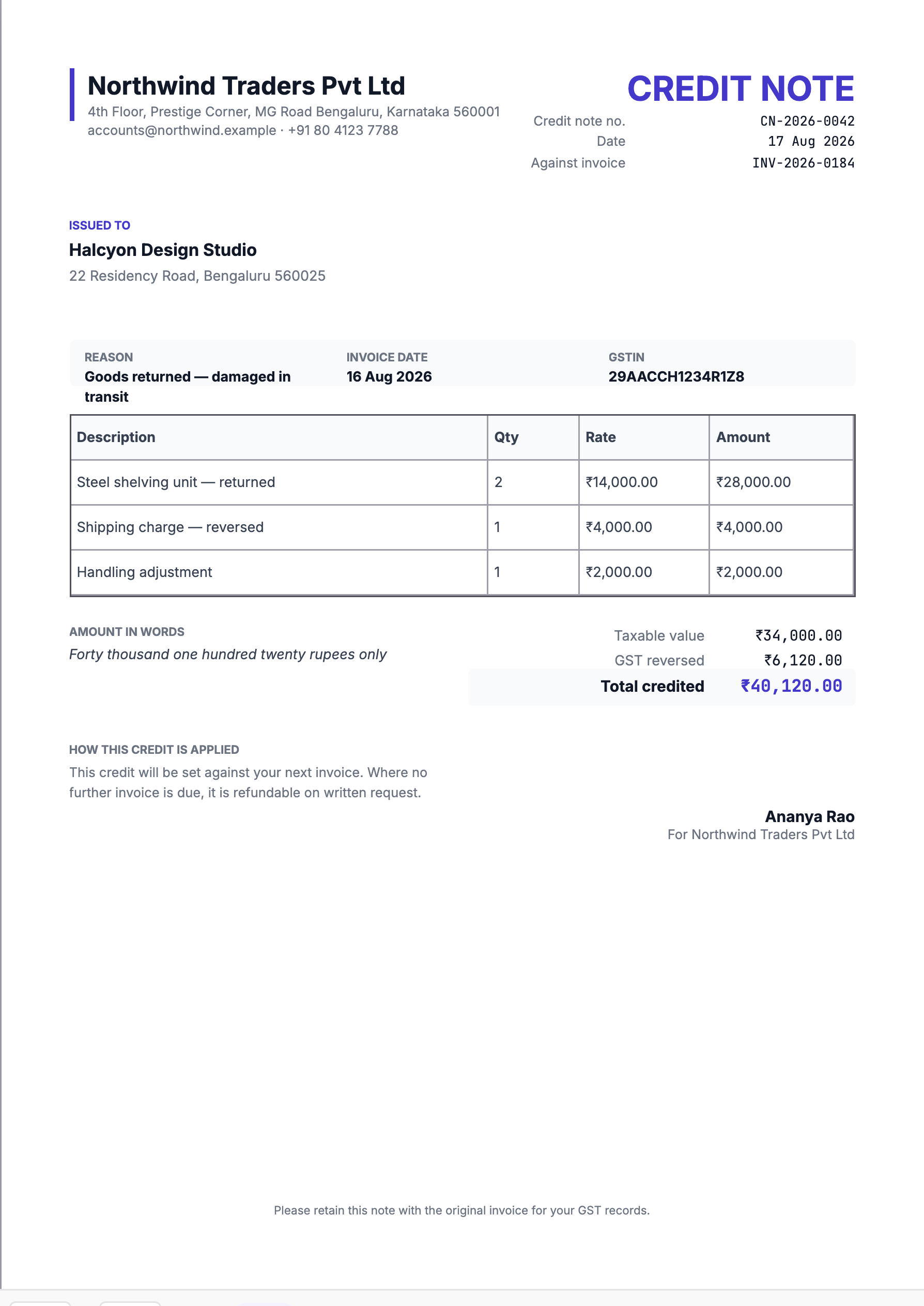
A credit note reduces what a customer owes on an invoice you have already issued — because goods came back, because you billed too much, or because a discount was agreed after the fact. It is the correct instrument for all three, and the one most often replaced by something worse.
Never fix an invoice by editing it
The temptation, when an invoice is wrong, is to reissue it with the same number and better figures. Do not. Your customer may already have booked the original and claimed credit on it; your GST return may already contain it; your invoice series now has two documents with one number and no way to tell which is which.
A credit note leaves the original standing and records the correction as its own event, with its own number and date. That is why the template carries against invoice and invoice date in the header — the note is meaningless without them, and a credit note that says only "as discussed" is a note that somebody will have to trace by hand.
What belongs on a credit note
| Field | Why |
|---|---|
| Credit note number | Unique, in a sequential CN series of its own. |
| Credit note date | When the credit was issued, not when the goods came back. |
| Against invoice | The original invoice number this adjusts. |
| Invoice date | The original's date, so the right one is found. |
| Issued to | The customer, with GSTIN where they are registered. |
| Reason | Return, rate correction, discount, cancellation. |
| Line items | What is being credited, with quantity and rate. |
| Taxable value | The value reversed, before tax. |
| GST reversed | Shown separately from the value. |
| Total credited | And the same figure in words. |
| Settlement | Whether it offsets a future invoice or is refundable. |
The reason field decides how the note is read
"Goods returned — damaged in transit" and "post-sale discount as agreed" are different transactions that happen to produce the same number at the bottom. One reverses a supply that did not stand; the other adjusts the price of a supply that did. Your auditor cares, your customer's auditor cares, and in six months neither of you will remember.
Write it in the note, not in the covering email. Two-thirds of a line is enough — what happened, and against what. Vague reasons are the reason credit notes get queried.
Reverse the tax separately from the value
Show the taxable value and the GST reversed as two lines, exactly as the original invoice showed them. A credit note that gives only a single figure — "credit ₹40,120" — forces the recipient to work backwards to a tax component, and they will round it differently from you.
The split matters because your customer has to reverse the input tax credit they already claimed. If they cannot see the ₹6,120 of tax on your note, they will either reverse the wrong amount or not reverse it at all, and the mismatch surfaces in a return reconciliation months later — as their problem first and yours immediately after.
Say how the credit is applied
A credit note reduces a balance. It does not, by itself, move money, and customers routinely assume otherwise. The template has a settlement block for this: set against the next invoice, refundable on written request where no further invoice is due, or whatever you have actually agreed.
Stating it also prevents the opposite failure — a credit sitting unused against an account that has gone dormant. If you issue many of these, run an ageing report on open credits the same way you run one on receivables. They are a liability, and they are far easier to overlook.