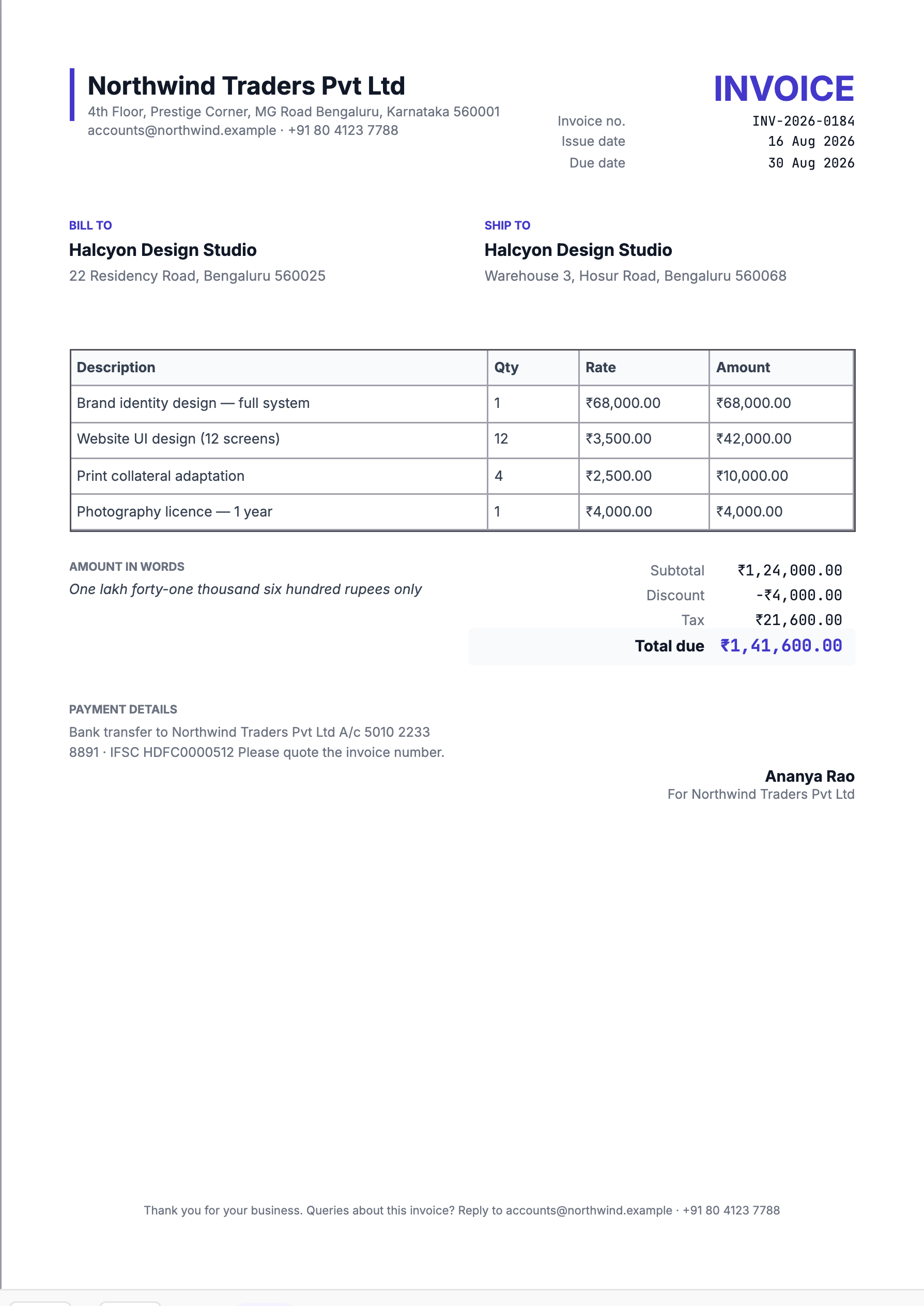
An invoice is a request for payment, and it is also a record. The second part is what people underestimate: months later, someone in accounts — yours or your customer's — will pull it up to answer a question. A good invoice answers that question without anyone needing to email you.
This template is laid out for that. Identity at the top, terms where they are easy to find, the arithmetic laid out so it can be followed line by line.
What an invoice needs to carry
Some of these are legal requirements depending on where you trade; all of them are practical ones.
| Field | Why it matters |
|---|---|
| Unique invoice number | The reference everyone quotes. Never reuse one. |
| Issue date | Starts the payment clock and fixes the accounting period. |
| Due date | "Net 30" is ambiguous across time zones and holidays. A date is not. |
| Your details | Legal name, address and tax registration if you have one. |
| Customer details | The entity being billed, not the person who asked. |
| Line items | Description, quantity, unit price, line total. |
| Totals | Subtotal, discount, tax, grand total — in that order. |
| Payment details | Where the money goes and what reference to quote. |
Invoice numbering that will not bite you
Sequential numbering is the default advice and it is right, but the common mistakes are worth naming.
Do not restart at 1 each year unless the number carries the year — 2026-0001
is fine, a second plain 0001 is not. Do not skip numbers to hide cancelled
invoices; issue a credit note instead,
because a gap in a sequence is exactly what an auditor asks about. Do not embed
the customer name in the number if you might ever rename them.
The safest scheme is boring: a fixed prefix, the financial year, and a counter that only ever goes up.
Getting paid faster
Most late payment is not refusal, it is friction. The fixes are small.
Put the due date in words a person reads, not just terms. "Due 30 August 2026" beats "Net 30" because nobody has to compute anything.
Name the payment reference explicitly. Untraceable bank transfers are a real cost — someone has to reconcile them by hand, and until they do, your invoice is still outstanding.
Send it to the person who pays, not the person who ordered. In most organisations these are different people, and an invoice sitting in the wrong inbox is invisible rather than late.
Include your own contact for queries. A disputed line item that takes three days to reach you is three days of the payment clock gone.
Adapting this template
The layout is a starting point, not a constraint. Widen the description column if your line items are wordy. Drop the discount row if you never discount — an always-zero row trains people to skim. Add a purchase order field if your customers work that way; for a lot of larger buyers, an invoice without a PO number is simply returned.
If you send more than a handful of these a month, it is worth wiring the template to your own system so the numbers, dates and line items come from the source of truth rather than being retyped. That is what the API is for, and it is available on the free plan.