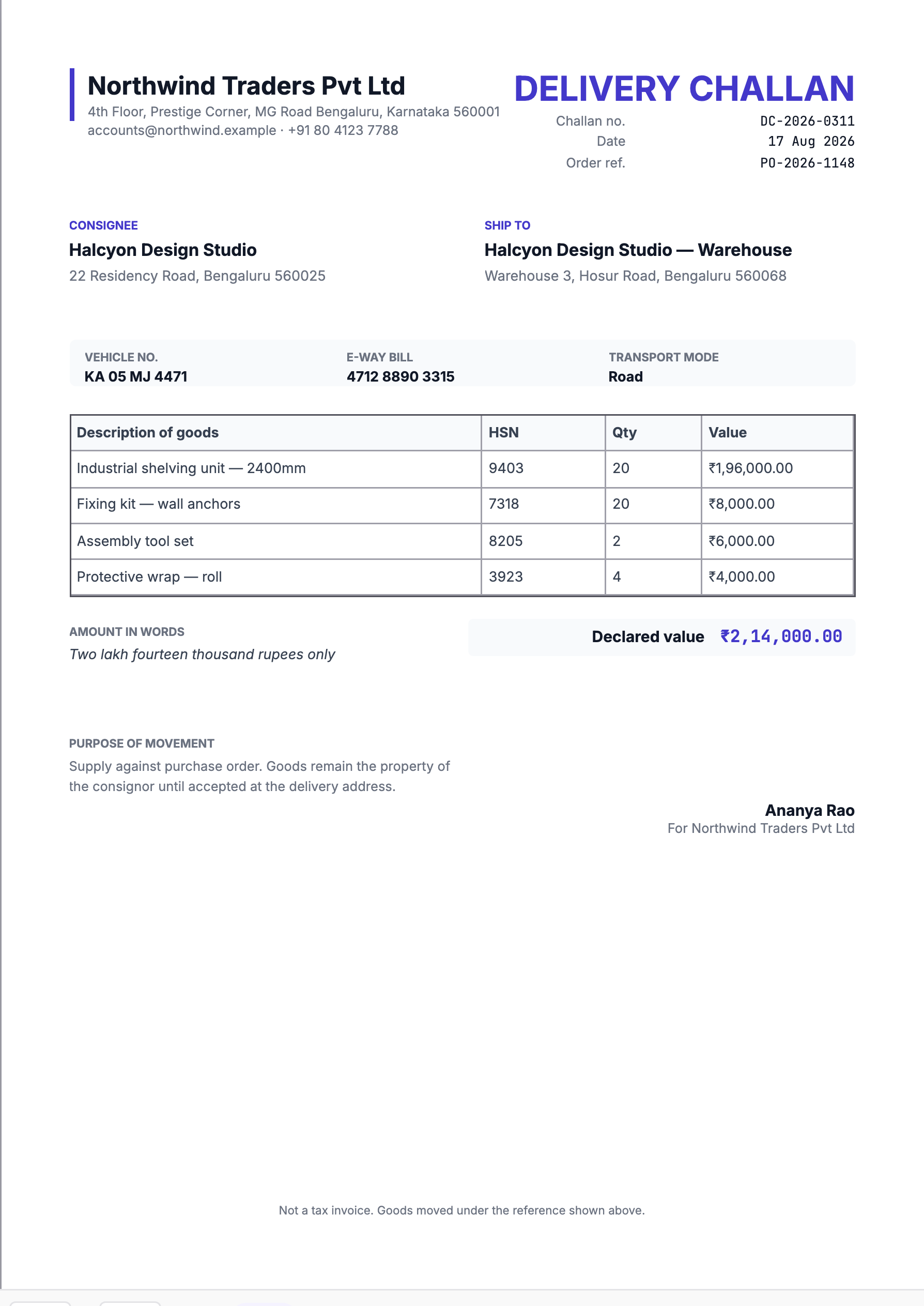
A delivery challan travels with the goods. It is not a demand for payment but a record of movement — what left, in what quantity, to which address, in whose vehicle — and it is the sheet the consignee counts the cartons against before signing.
Every field on it answers a question someone asks at the far end of the journey, or at the roadside in the middle of it.
What belongs on a delivery challan
| Field | Why |
|---|---|
| Challan number | So the movement can be referred to on its own. |
| Date | When the goods left. |
| Order reference | The PO or contract that authorised the despatch. |
| Consignee | The party the goods belong to on arrival. |
| Ship to | The address the vehicle actually goes to. |
| Description, HSN, quantity | What is in the boxes, line by line. |
| Declared value | For the e-way bill and for insurance — not a bill. |
| Vehicle and e-way bill | How the goods travel, and under what authorisation. |
| Purpose of movement | Sale, job work, approval, stock transfer, return. |
| Signature | For the consignor, with a name. |
Consignee and ship-to are rarely the same address
The consignee is the customer — the registered office, the address that appears on the invoice. The ship-to is a loading bay somewhere else entirely.
Collapse the two and a driver arrives at a first-floor design studio with twenty shelving units. Or, worse, reaches the right warehouse with paperwork naming an office address, and gate security turns the vehicle away. Name the site in the ship-to line — "Warehouse 3", "Gate 2", "Stores" — not just the company.
Declared value is not a price
Goods move for plenty of reasons that are not sales: stock transfers between your own locations, material sent out for job work, samples on approval, exhibition stock, replacements under warranty. The declared value exists so the e-way bill can be raised and so there is a number to point at if the consignment is damaged or lost. It is not an amount anyone owes you.
That is why the footer says this is not a tax invoice and why there is no tax breakup on the page. A challan does not postpone an invoice — where one is due it is still due, and it should quote the challan number so the two tie together.
State the purpose of movement in a full sentence rather than one word. "Supply against purchase order; goods remain the property of the consignor until accepted at the delivery address" tells a reader what is happening. "Delivery" does not.
The vehicle number has to survive the journey
Challans are printed before the vehicle is loaded, and vehicles change — a transhipment at a hub, a breakdown, a smaller truck for the last stretch into the city. If the registration on the paper is not the one on the plate, that is the discrepancy an inspection finds first.
Write the number spaced the way the plate is spaced, so it can be matched by eye. Quote the e-way bill in full and check it against what was generated; a transposed digit sends whoever is verifying it to a record that does not exist, and the natural conclusion is that no e-way bill was raised at all.
Copies, numbering and the signature that matters
The convention is three copies — original for the consignee, duplicate for the transporter, triplicate retained by you. Number them in one unbroken series per location. Gaps are the kind of thing an auditor stops on, because a missing number looks like a despatch someone removed.
The signature block here is the consignor's. The signature that actually protects you is the one the consignee writes on your copy at delivery, so make sure whoever collects it takes a printed name and a date alongside the scrawl. An unnamed signature proves somebody at that address touched the paper, and nothing more.