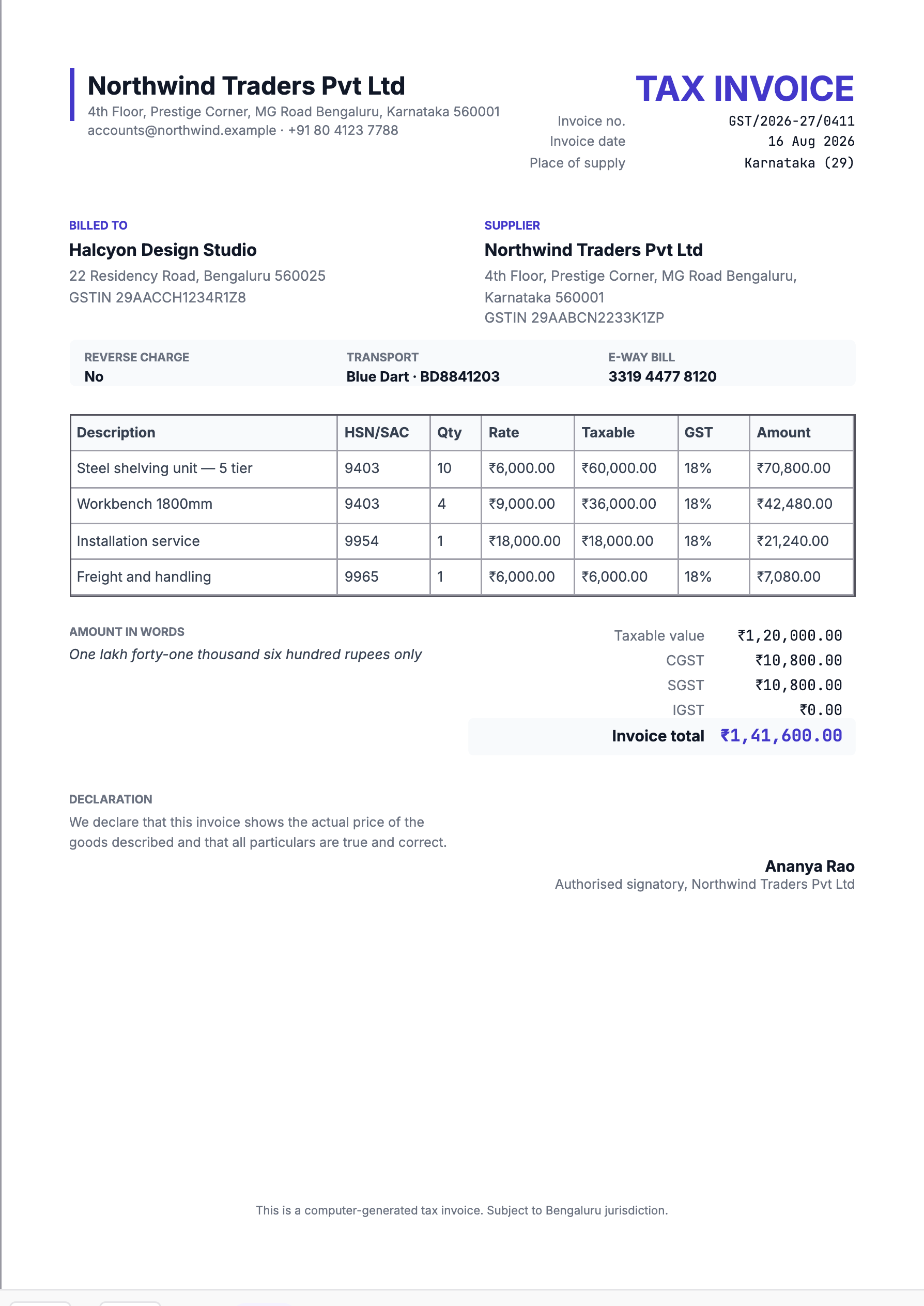
A tax invoice under GST is a stricter document than an ordinary invoice. It is the thing your customer relies on to claim input tax credit, which means a missing field is not a cosmetic problem — it can cost the person you are billing real money, and they will notice.
This template carries the fields a compliant tax invoice is expected to show, laid out so nothing is buried.
The fields a tax invoice must show
| Field | Notes |
|---|---|
| Supplier name, address, GSTIN | The registered details, exactly as registered. |
| Invoice number | Unique, sequential, and no more than 16 characters. |
| Invoice date | The date of issue. |
| Recipient name, address, GSTIN | GSTIN only where the recipient is registered. |
| Place of supply | With the state code — this decides the tax split. |
| HSN or SAC code | Per line. Goods use HSN, services use SAC. |
| Description, quantity, unit | What was actually supplied. |
| Taxable value | Per line, after any discount. |
| Rate and amount of tax | CGST, SGST/UTGST and IGST shown separately. |
| Total invoice value | And, where applicable, in words. |
| Reverse charge | Whether tax is payable on reverse charge. |
| Signature | Of the supplier or an authorised representative. |
CGST and SGST, or IGST — the split follows place of supply
This is the part that most often goes wrong, and it is worth being precise about because the answer does not depend on where your customer's office is. It depends on the place of supply.
If the place of supply is in the same state as the supplier, the tax is split into CGST and SGST — half each. If it is in a different state, or the supply is an import or export, it is IGST at the full rate.
So a Bengaluru supplier billing a Bengaluru customer charges 9% CGST plus 9% SGST on an 18% item. The same supplier billing a Chennai customer charges 18% IGST. The total is identical; the split is not, and getting it wrong means your customer cannot claim correctly.
The template shows all three rows. Leave the ones that do not apply at zero rather than deleting them — a reader scanning for IGST should find it and see zero, not wonder whether you forgot.
HSN and SAC codes
How many digits you need depends on your turnover, and the threshold has moved over the years — check the current requirement rather than copying an old invoice. The practical advice: store the code against the product in whatever system you sell from, so it is never typed by hand on an invoice. A wrong HSN code is the kind of error that gets copied forward indefinitely.
Amount in words
The template has a line for it because it is conventional on Indian invoices and because it catches transcription errors — a figure and its written form disagreeing is immediately visible in a way that a wrong digit is not.
Note that it has to be supplied as text. Nothing here converts a number to words for you; if you are generating invoices automatically, your system should produce that string alongside the total.
A note on what this template is
It is a layout that carries the right fields, not tax advice, and it does not compute anything. GST rules change, and how they apply depends on what you sell and to whom. If you are setting up invoicing for a new business, have the first few checked by someone who does this professionally — it is much cheaper than correcting a year of invoices.