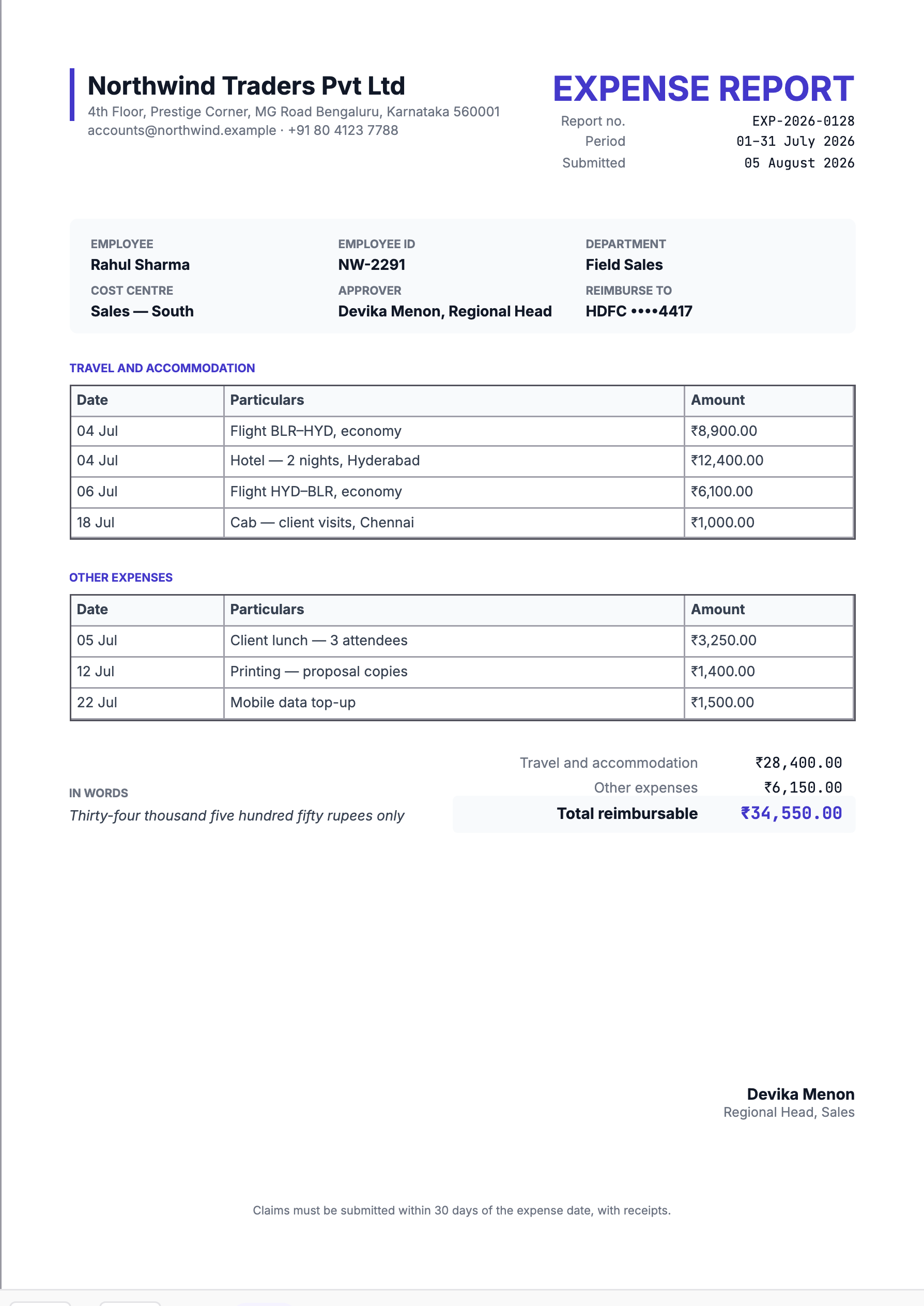
An expense report is a claim, which means somebody has to decide whether to pay it. Everything on the page should make that decision take thirty seconds rather than a chain of emails asking what the ₹12,400 in Hyderabad was for.
The reports that get paid quickly are not the ones with the smallest numbers. They are the ones where every line has a date, a description a stranger can follow, and a receipt behind it.
Three dates, and only one of them is the deadline
The template carries a claim period — "01–31 July 2026" — and a submission date, 05 August. Each line then carries its own date. People treat these as bookkeeping, and then get caught by the third one.
The submission window in most expense policies runs from the expense date, not from the end of the month you are filing for. A flight taken on 4 July and filed on 5 August sits inside a thirty-day rule. The same flight rolled into a September claim because the employee was travelling does not, and the finance team declining it is following policy rather than being difficult.
So do not hold expenses back to batch them. If a trip straddles month end, split it across two reports at the calendar boundary — a report numbered for July with August lines in it is the version that comes back untouched.
Travel and other expenses are separated for a reason
The template gives them two blocks and two subtotals: ₹28,400 travel and accommodation, ₹6,150 other. That is not formatting. Travel is usually budgeted separately from general departmental spend, often approved by someone different, and it is the category sampled first in any review.
Keep the split honest. A client lunch during a Hyderabad trip is hospitality, not travel, even though it happened on the road. Airport parking is travel. Coding by convenience makes the travel subtotal meaningless, and that subtotal is the one number the budget holder actually looks at.
Within travel, dates get checked against the trip. "Hotel — 2 nights, Hyderabad" dated 4 July, alongside flights out on the 4th and back on the 6th, tells a consistent story. A hotel line with no date and no city does not, and will be queried whether or not it is genuine.
Write descriptions for someone who was not there
"Client lunch — 3 attendees" is approvable. "Lunch" is not. "Printing — proposal copies" is approvable. "Printing" invites a question.
The test: an approver who was not on the trip should be able to tell what was bought, why the organisation benefited and whether the amount is plausible, without asking. Four extra words cost nothing. Leaving them out costs a week in somebody's tray.
Reimburse-to, and keeping claims out of the payroll run
The template shows a masked account — "HDFC ••••4417" — rather than a full number, which is the right instinct: enough to confirm which account, not enough to be worth anything if the PDF reaches the wrong person. Check it against the employee record each time, especially for anyone who has changed banks. A reimbursement paid into a closed account is less a lost payment than a three-week reconciliation.
Pay reimbursements separately rather than folding them into the next salary run. They are repayment of money the employee already spent on the organisation's behalf, not earnings — putting them on a payslip makes gross pay wrong and buries the spend in payroll cost, where no budget holder will ever see it.
What the approver is actually signing
The signature block names a person and a title — "Devika Menon, Regional Head, Sales" — because approval is personal. Signing is a statement that the spend was incurred on company business, was within policy, and belongs to the cost centre shown.
Which means approving the total is not approving the report. Read the lines. The item that causes trouble later is almost never the ₹12,400 hotel; it is the small recurring one — a ₹1,500 mobile top-up claimed every month by someone whose phone is already on a company plan — that nobody looked at because the total seemed reasonable.