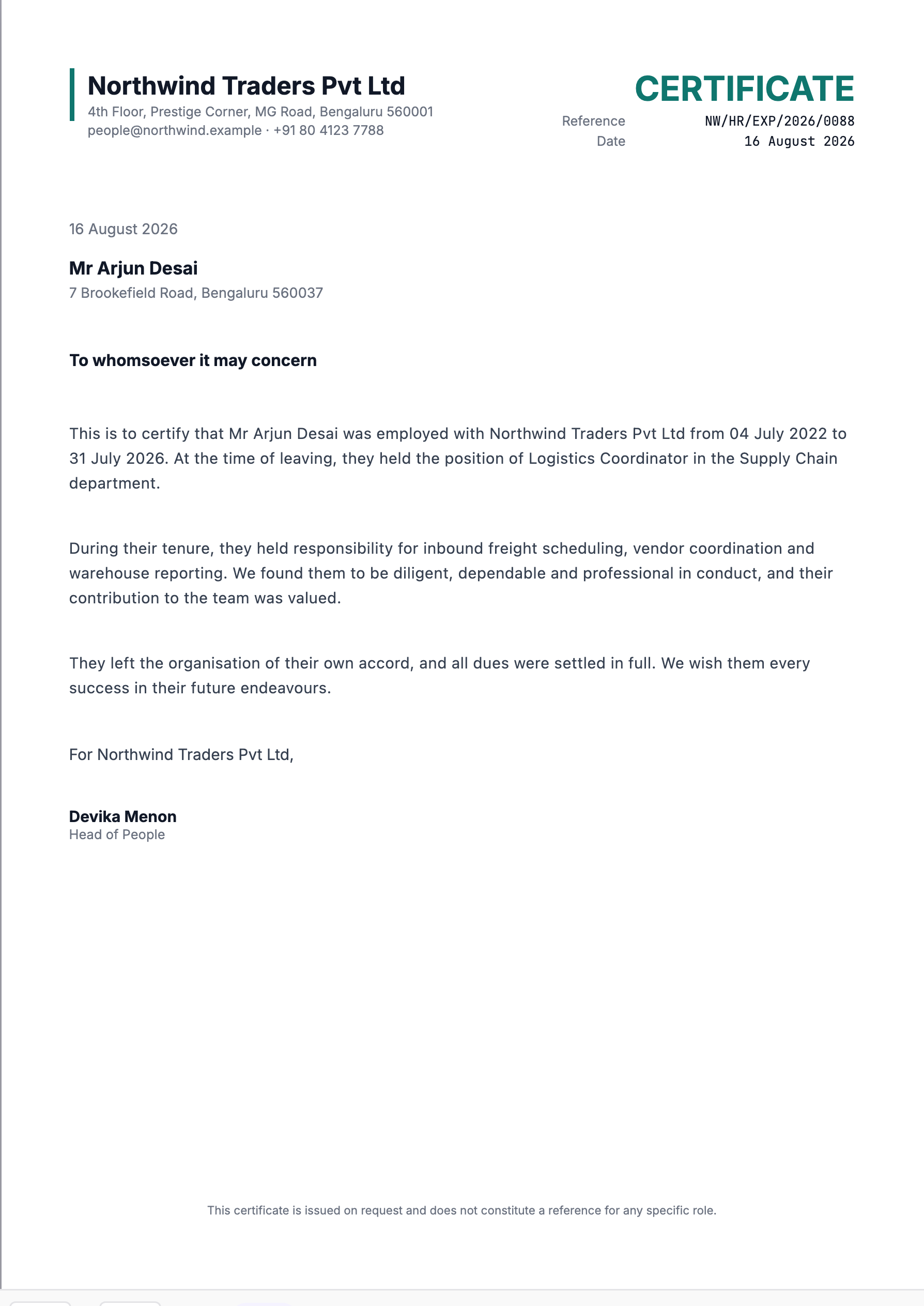
An experience certificate is a short document with an outsized effect. It is what a former employee hands to their next employer, a visa officer, or a background-check firm, and it is often the only proof they have that the employment happened at all.
Which means the details need to be right, and it needs to arrive promptly. A certificate that takes six weeks to issue is a real obstacle to someone's next job.
What it must confirm
The core of the document is four facts:
- Who — the employee's full name, as it appears in your records.
- How long — exact start and end dates, not just years.
- What role — the designation held at the time of leaving.
- In what department or function — enough context to be meaningful.
Everything else is commentary. Those four are what gets verified.
Be exact with dates
Background-check firms compare your certificate against what the candidate declared and, sometimes, against payroll records. A mismatch — even by a month — gets flagged, and the candidate has to explain it.
Use the actual first and last working days from your records. If someone joined on 4 July and the offer said 1 July, the certificate says 4 July. It is not a discrepancy if the document is accurate; it is a discrepancy if two of your documents disagree.
Experience certificate or relieving letter?
They are different documents and people frequently ask for one meaning the other.
An experience certificate confirms the employment happened and describes the role. It is addressed to whomsoever it may concern, and it is the one used for future job applications.
A relieving letter confirms the employee has been formally released, served their notice, and has no outstanding obligations. It is what a new employer asks for before onboarding.
Most people leaving on good terms need both. It is worth issuing them together rather than waiting to be asked twice.
On the conduct line
Conventional certificates include a sentence about conduct — "we found them diligent and professional". It is fine to include, and it is fine to keep it general.
What is worth avoiding is anything that reads as coded criticism. Employers do read these closely, and a certificate that omits the usual courtesy line stands out. If someone left on genuinely poor terms, the honest options are a strictly factual certificate with no conduct comment at all, or a conversation with your own advisers — not a softly negative adjective that the reader has to decode.
Note also that this template uses neutral pronouns throughout. That avoids a whole category of embarrassing correction, and it is one fewer field to get wrong.
Issue it without being chased
The single biggest improvement most organisations could make here is timing. Make the certificate part of the exit process rather than a request handled afterwards. The person is leaving on a known date, all the details are already in your system, and generating it in advance costs nothing.