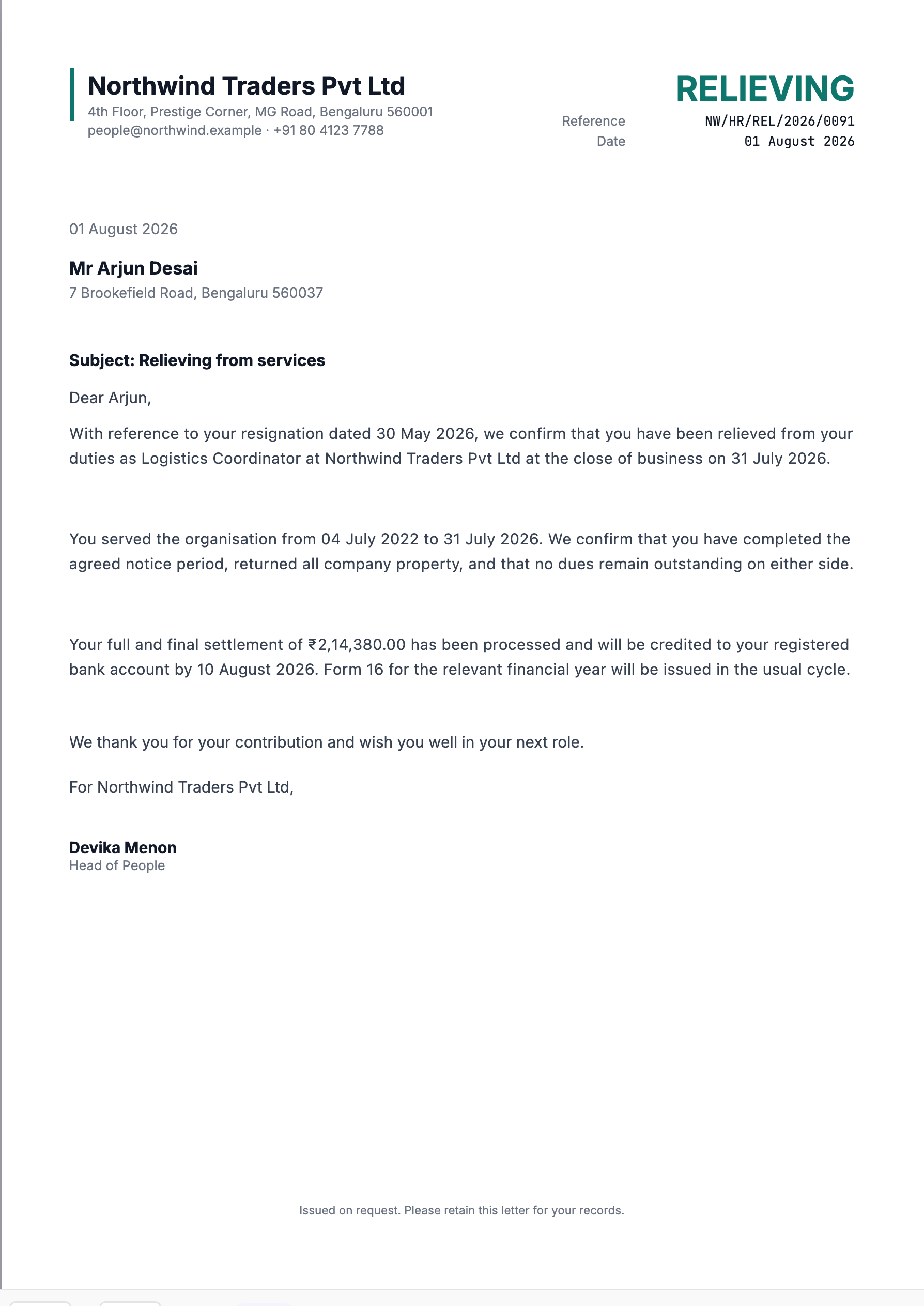
A relieving letter is the document a new employer asks for before they will let someone start. It confirms one thing above all: that the person is genuinely free to join, with nothing outstanding on either side.
Withholding it, or issuing it late, has a direct effect on somebody's next job. It is worth treating as time-sensitive rather than administrative.
The standard relieving letter format
There is no statutory format in India, which is exactly why people search for one — every company writes its own and nobody is certain what a correct one looks like. In practice the accepted structure is short, and a background-check firm reads it in the following order.
- Company letterhead — registered name, address, and a way to make contact.
- Reference number and date of issue, so the letter can be traced in your records.
- Employee name, address and employee code.
- Designation held at the point of leaving, and the department.
- Date the resignation was received.
- The last working day, stated exactly, not as "end of March".
- The notice position — served, waived, or bought out.
- Company property returned.
- Dues settled, or the date they will be.
- A closing line releasing the employee from their obligations.
- Authorised signatory — name, designation, signature, and the company seal.
Anything beyond that is padding. One page is normal, and a letter that runs longer usually means someone has mixed in the responsibilities and conduct that belong on a different document.
The notice line is the one background-check firms look for. "Completed the agreed notice period" is a clean statement. If notice was shortened by mutual agreement, say that instead — it is neutral, and it is better than silence, which reads as a problem.
What makes it an "original" relieving letter
This is the thing most people are actually asking, usually the week a new employer has asked for the original and they are not sure what they are holding is one.
A relieving letter is treated as genuine when it carries the marks that let a third party verify it:
- It is on the company's actual letterhead, not a plain-paper reproduction.
- It is signed by a named authorised signatory whose designation is printed under the signature. "For XYZ Pvt Ltd" over an illegible squiggle is what gets queried.
- It carries a date of issue and a reference number.
- It has the company seal or stamp, where the organisation uses one.
- The details on it — dates, designation, spelling of the name — match every other document the employee has. A last working day that disagrees with the experience certificate is the most common reason a file gets held up.
A digitally signed PDF issued from the company's own HR system is accepted by most employers and by every background-check firm operating in India; a photograph of a printout generally is not. If you are asked for a "hard copy original", that means a signed printout on letterhead, posted or handed over.
None of this is a route to producing a letter you were not given. A relieving letter asserts facts only a former employer can assert, and every one of the marks above exists so that a third party can check them. If you are missing one, the section below is the honest way through.
Relieving letter, relieving certificate, experience certificate
These get conflated constantly, and the words are used loosely.
The relieving letter releases the employee. It is about the exit — the last working day, the notice period, the settlement. Some organisations call the same document a relieving certificate; there is no meaningful difference, and a new employer asking for either will accept the other.
The experience certificate describes the employment — dates, role, responsibilities, conduct. It is what a candidate shows future employers to evidence their background, and it is often called a service certificate.
Most people need both, and they are cleanest as separate letters. Issuing them at the same time is a kindness that costs nothing.
Full and final settlement
If the settlement is already processed, state the amount and the date it will be credited. If it is not, say when it will be — an unstated settlement is the single most common reason former employees keep contacting HR.
Mention Form 16 if it will follow separately. People need it for their tax return and will otherwise ask.
If your employer has not given you one
This is common enough to plan for, and the order matters.
Ask HR in writing — email, not a call — and name the document, your last working day and your employee code. A written request creates the record you will need if the matter escalates, and it is very often enough on its own.
If there is no response, escalate once to your reporting manager and to the HR head together, restating the same facts. Keep it factual and short.
Where the letter is genuinely being withheld, most employers will accept an alternative in the meantime: a resignation acceptance email, your last three payslips, the experience certificate if that was issued, or Form 16, which independently evidences the employment and its end date. Tell your new employer early rather than at the deadline — a background-check firm can usually work around a missing relieving letter, but not around a surprise.
Do not use it as leverage
It is worth saying directly. Relieving letters are sometimes delayed to enforce a notice period or resolve a dispute, and it is a poor idea: it damages the person's next job rather than resolving anything with you, it makes your organisation's reputation with candidates measurably worse, and depending on jurisdiction it may not be lawful.
If there is a genuine outstanding obligation, address it directly rather than through the letter.
Make it part of the exit process
The last working day is known well in advance. Every field on this letter exists in your records before the day arrives.
Generating it ahead of time and handing it over on the final day — alongside the experience certificate — turns a chase into a non-event. It also removes the awkward position of a former colleague having to email a company they have left asking for something they are owed.