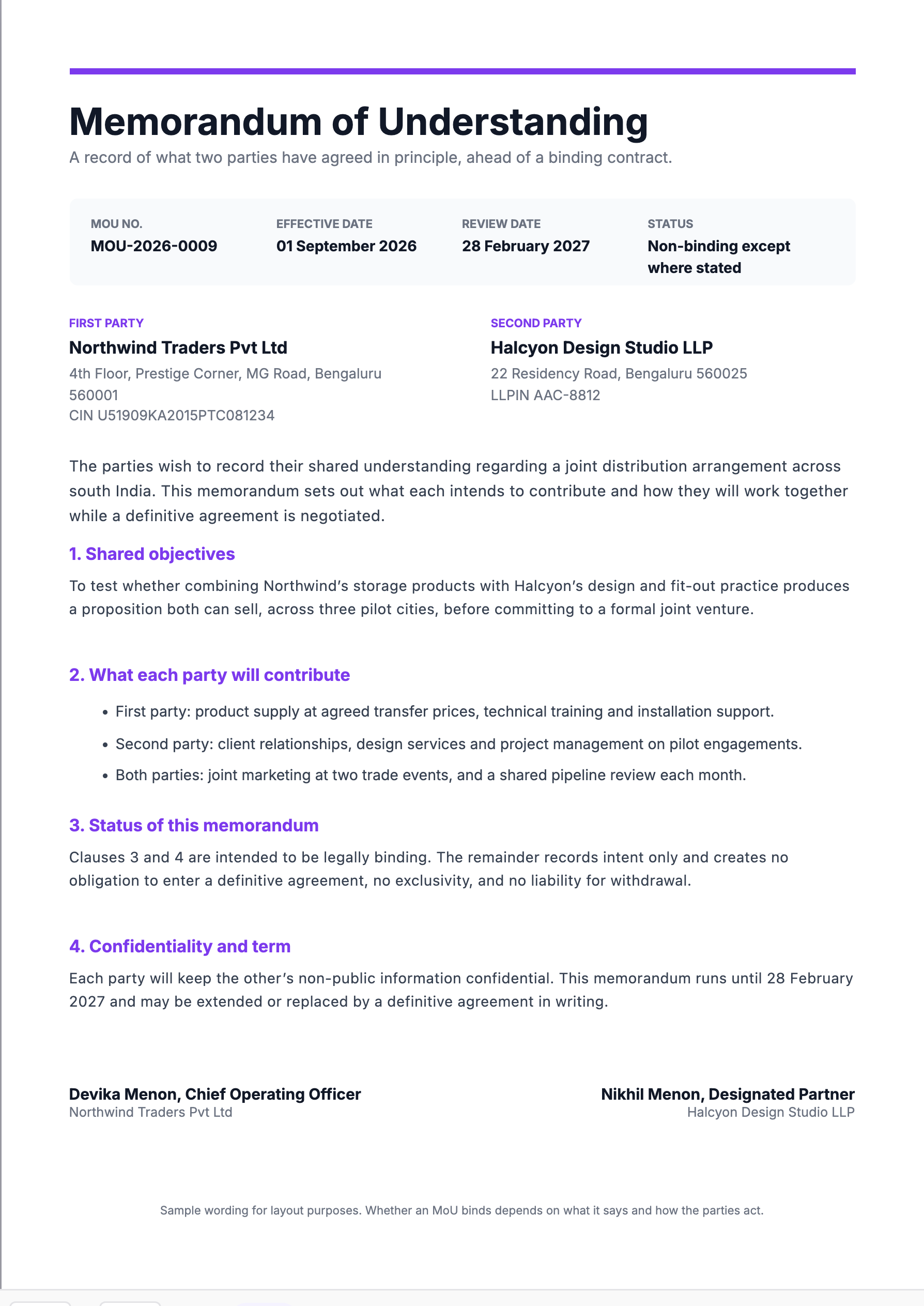
An MoU is what two organisations sign when they have agreed the shape of something but not the detail, and want the shared understanding on paper before either side spends money on it. Its usefulness depends almost entirely on one thing — whether it is honest about what it binds.
What belongs on an MoU
| Field | Why |
|---|---|
| MoU number and date | So it can be referred to in later correspondence. |
| Both parties' legal names | With CIN, LLPIN or registration number. |
| Purpose | The specific arrangement being explored. |
| Objectives | What success would look like, and by when. |
| Contributions | What each side brings, listed separately. |
| Binding status | Which clauses bind and which record intent only. |
| Confidentiality | What happens to information exchanged meanwhile. |
| Review date | When the arrangement is reconsidered or replaced. |
| Signatories | Named, with the office each holds. |
Binding, non-binding, or partly both
Most MoUs are partly both, and the sample here says so explicitly: two clauses are intended to bind, the rest records intent. That is the honest shape, and it is worth writing out clause by clause rather than stamping "non-binding" across the top.
A heading does not settle the question. What matters is the language in the body and how the parties then behave. A memorandum saying the parties shall pay, deliver or negotiate exclusively has created obligations whatever the cover page claims — and so has one where both sides quietly start performing as though a contract exists.
The clauses that usually should bind are confidentiality, costs (each side bears its own), and exclusivity if there is any. The ones that usually should not are the commercial terms still being negotiated. Say which is which, by number.
The contributions section is where MoUs go soft
The template splits contributions three ways — first party, second party, and both. The third row is the one that quietly fails.
"Joint marketing at two trade events, and a shared pipeline review each month" is better than "joint marketing" because it is countable. It still does not say who books the stand, who pays for it, or who chairs the review. Anything in the shared row needs an owner and a number attached, or it becomes the thing each side assumed the other was handling.
The individual rows are easier. Write them as verbs with objects. "Product supply at agreed transfer prices, technical training and installation support" tells the other side's operations team what to expect on Monday. "Support and cooperation" tells them nothing at all.
Objectives, the review date, and how it ends
An objective worth writing has a test attached. The sample sets one: find out whether the combined proposition sells across three pilot cities before committing to a formal joint venture. That can be answered yes or no in February.
The review date is what stops an MoU drifting. Without one, these documents sit in a drawer for two years while people carry on citing them — long after the pilot finished or the sponsor on one side left the organisation. Set a date, put it in both sides' calendars, and decide at it: extend, replace with a definitive agreement, or let it lapse.
Confidentiality deserves one deliberate decision rather than a reflex. If the parties already signed an NDA, refer to it instead of writing fresh wording. Two confidentiality clauses with different scopes are worse than either one on its own, because the argument then starts with which of them applies.
The wording here is a starting point
Whether an MoU binds depends on what it says and on how the parties act, and the answer shifts with the situation and the state you are in. Use this to draft the version that matches your arrangement, and have anything with real money behind it reviewed before signature — particularly the binding-status clause, which is the one people read closely only after the relationship has already gone wrong.