A packing list is read standing up, at a loading bay, by someone with a pen and about ninety seconds. Every design decision on it should follow from that.
It answers one question — is everything here — and it has to answer it in a form that survives being checked against fourteen cartons on a wet Tuesday.
What belongs on a packing list
| Field | Why |
|---|---|
| Packing list number | So the document can be referred to on its own. |
| Date | When the consignment was packed. |
| Invoice reference | Ties the shipment to the commercial paperwork. |
| Consignee | Who bought the goods. |
| Deliver to | Where they physically go — often not the same. |
| Contents | Per line, in words a warehouse hand recognises. |
| Carton | Which carton or range each line is in. |
| Quantity | Pieces, not cartons. |
| Weight | Per line, so a discrepancy can be localised. |
| Total cartons | The count the driver signs for. |
| Net and gross weight | Goods, and goods plus packaging. |
| Handling | Anything that changes how it is moved or stored. |
There are no prices on it, deliberately. The packing list travels with the goods, so it is seen by the carrier, the security guard and whoever is at the gate. Values belong on the invoice, which travels separately — and that separation is why the invoice reference field exists.
The consignee and the delivery address are different fields
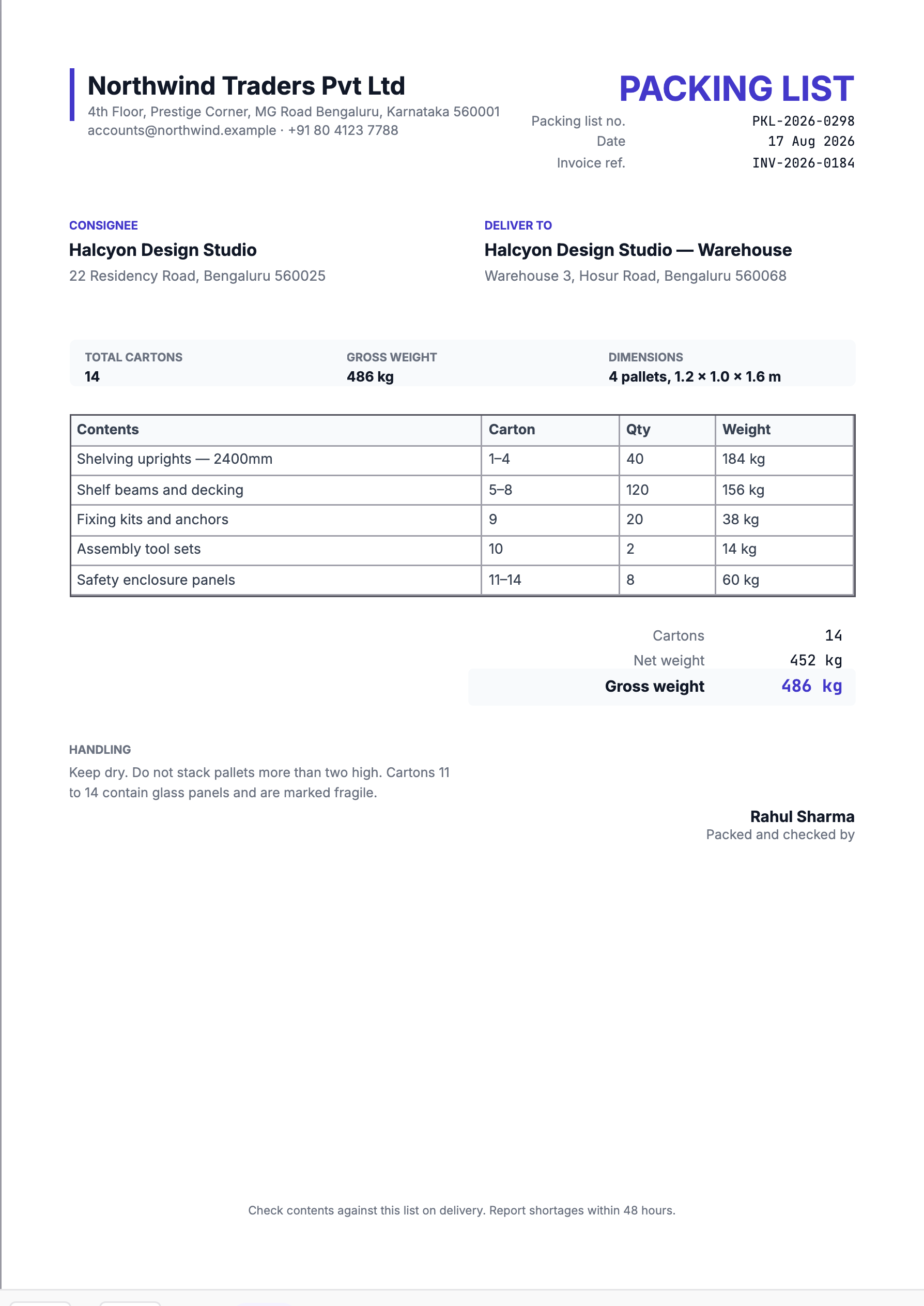
The template has both because they diverge constantly. The consignee is the party that bought the goods — Halcyon Design Studio, at their Residency Road office. The delivery point is their warehouse on Hosur Road, ten kilometres away, which is where a driver with a fourteen-carton pallet load actually needs to go.
Collapse the two and four pallets arrive at a design studio with no forklift and nowhere to put them. The redelivery charge is the small part of that; the lost day is the large one.
Carton ranges are what make a shortage provable
The most useful column on the document is the one saying which carton each line is in. "Shelving uprights — cartons 1 to 4. Fixing kits — carton 9. Safety enclosure panels — cartons 11 to 14."
When the receiving side reports a shortage, this column turns a vague claim into a specific one. "Carton 9 is missing" tells you at once that the fixing kits and anchors are gone, that nothing can be installed without them, and that the remedy is a small parcel rather than a re-shipment. "Something is missing from the delivery" tells you nothing and takes a week to resolve.
Number the cartons physically, in marker, to match the list. A carton range that corresponds to nothing written on the boxes is decoration.
Net weight, gross weight, and the number the carrier bills on
Net weight is the goods. Gross weight is the goods plus cartons, pallets, strapping and stretch wrap — 452 kg against 486 kg on the sample consignment. Both are here because both get used, by different people.
The receiving side reconciles against net. The carrier bills against gross, and often against volumetric weight instead — four pallets at 1.2 × 1.0 × 1.6 m is 7.7 cubic metres of truck, which on a light, bulky load can cost more than the mass does. That is why the dimensions field sits alongside the weights rather than being left to the consignment note.
Handling notes, and the name at the bottom
"Keep dry. Do not stack more than two pallets high. Cartons 11 to 14 contain glass panels." Write it on the list as well as on the boxes. Markings on a carton disappear under stretch wrap and pallet labels; the paper is what the person directing the forklift is actually holding.
The signature block names the person who packed and checked the consignment, not the company. When a claim comes back three weeks later, a name means somebody can be asked what went into carton 9 — and, more often than anyone admits, remembers.