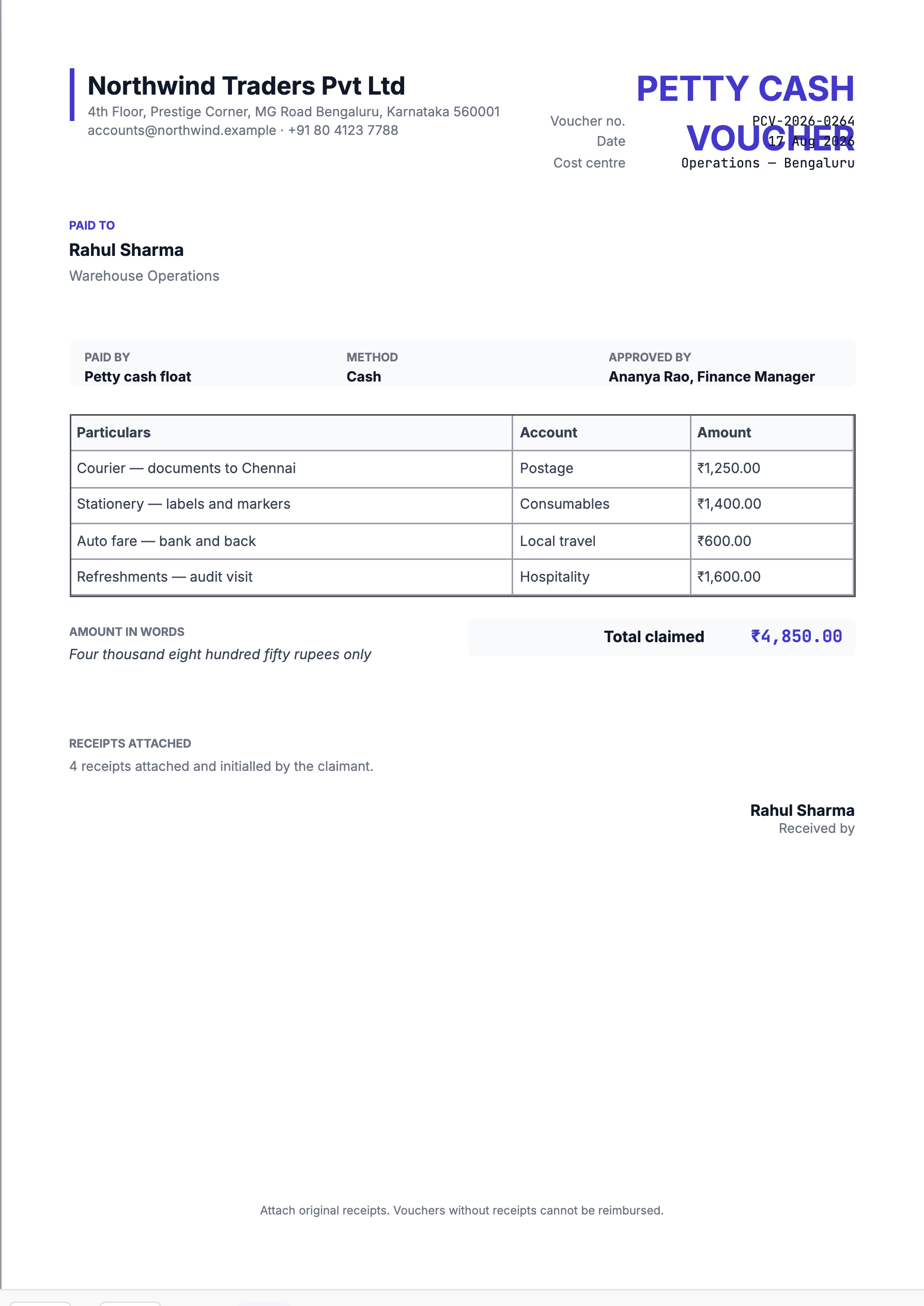
Petty cash is the only place in most organisations where money leaves a drawer without passing through a bank. That is exactly why it needs paperwork: there is no statement to reconcile against, so the voucher is the record.
A ₹1,250 courier charge is not worth an argument. Two hundred of them, unrecorded over a year, is a hole nobody can explain.
What a petty cash voucher records
| Field | Why |
|---|---|
| Voucher number | Sequential, so a missing voucher is visible. |
| Date | When the cash was handed over. |
| Paid to | The person receiving the money, with department. |
| Cost centre | Which budget the spend lands against. |
| Paid by | Which float or drawer it came out of. |
| Method | Cash, or a card the office holds. |
| Particulars | What was actually bought, line by line. |
| Account | The expense head each line is coded to. |
| Amount | Per line, and the total claimed. |
| Approved by | Name and role of whoever authorised it. |
| Receipts | How many are attached. |
| Received by | The claimant's signature, on collection. |
The account column is what makes the float reconcilable
Most petty cash books have a description and an amount, and the coding happens at month end when someone in accounts reads "auto fare — bank and back" and guesses. Coding at the point of payment is the difference between a float you can report on and a lump labelled "sundries".
Four lines split across Postage, Consumables, Local travel and Hospitality cost the claimant ten seconds, and mean that ₹1,600 of refreshments for an audit visit lands in hospitality — where somebody may reasonably question it — rather than vanishing into office expenses, where nobody ever will.
Keep the list of heads short: six or eight that match your chart of accounts. A long list produces inconsistent coding, which is worse than none because it looks reliable.
Receipts, and the signature people skip
Two signatures live on a voucher and they do different jobs. The approver authorises the spend; the claimant signs to acknowledge that cash was physically handed over. The block on this template is the second — "received by" — and it is the one that gets missed, because the money has changed hands by the time anyone thinks about paper. Get it signed at the drawer: a voucher without it cannot distinguish money paid out from money missing.
Staple the original receipts and have the claimant initial each. Photocopies and phone photographs are how one bill gets claimed twice, once in cash and once on a card statement. Where a receipt genuinely does not exist — a parking attendant, a porter — write that on the voucher rather than leaving the line unsupported.
Approval has to come from someone who is not the payee
This is the control that fails first in small offices. The person holding the float writes the voucher, spends the money and signs their own approval, because there is nobody else in the room. It is not fraud; it is an arrangement in which fraud would be undetectable, and auditors treat those the same way.
Name a specific approver with a role — "Ananya Rao, Finance Manager", not "Manager" — and set a per-voucher ceiling above which spend goes through normal purchase approval. Petty cash exists for amounts too small to justify a purchase order; the moment a voucher is big enough to matter, it should not be a voucher.
Run the float on an imprest basis
Fix the float at a round figure — ₹10,000, ₹25,000 — and top it up by exactly what has been spent, against the vouchers, rather than handing over cash whenever the tin looks empty. Cash in the drawer plus vouchers not yet reimbursed should equal the float at any moment of any day, so a shortfall surfaces the same week rather than at year end.
One caution on size: Indian income tax rules cap the value of a single cash payment that can be claimed as a deductible business expense, and the threshold has moved over the years. Check the current figure before routing anything substantial through the tin.