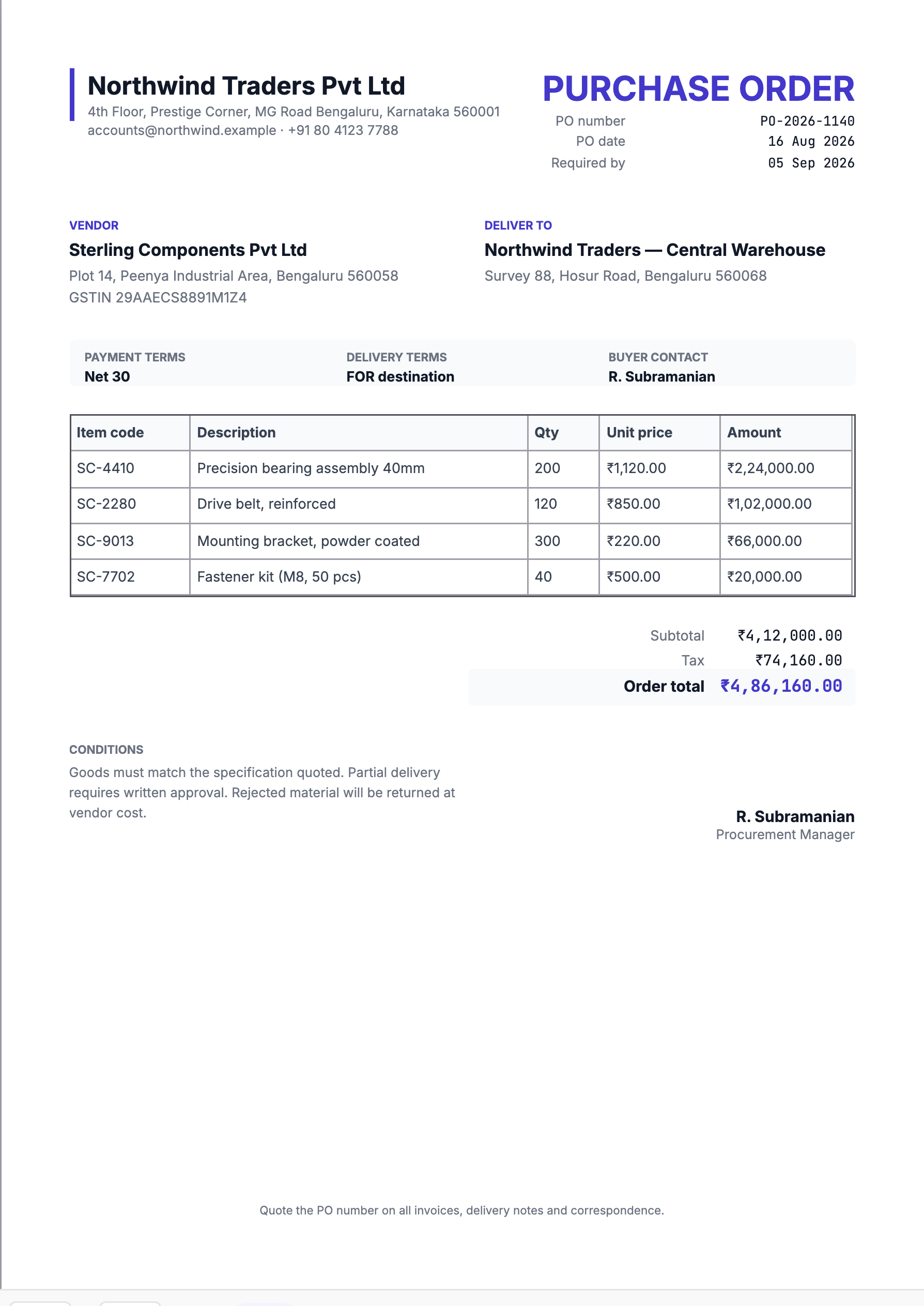
A purchase order is an offer to buy on stated terms. Once the vendor accepts it, you have a contract — which is why a PO deserves more care than its reputation as routine paperwork suggests.
It is also, in most organisations, the control that stops money being spent without approval. That is its real job.
What a purchase order commits you to
The PO fixes four things: what you are buying, how many, at what price, and by when. If any of those is vague, you have not removed the ambiguity, you have moved it to the delivery note.
| Field | Why it matters |
|---|---|
| PO number | The reference that ties order, delivery and invoice together. |
| Vendor details | Including tax registration, so the invoice can be matched. |
| Deliver-to address | Often not the billing address. Say both if they differ. |
| Required-by date | A date, not "ASAP". |
| Item code | The vendor's code where possible — it removes description ambiguity. |
| Quantity and unit | With the unit stated. "12" of what? |
| Unit price | Agreed in advance, not filled in from the invoice later. |
| Terms | Payment terms, delivery terms, and who bears freight. |
Three-way matching, and why the PO number matters so much
The standard control in accounts payable is a three-way match: the purchase order, the goods received note, and the vendor's invoice must agree before payment is released.
That only works if all three carry the same PO number. This is the single most common reason invoices sit unpaid — not a dispute, just an invoice nobody can match to an order. The template puts the PO number in the header and repeats the instruction in the footer, because vendors do read footers when they are preparing an invoice.
Item codes beat descriptions
"Precision bearing assembly 40mm" is a description a human understands and a
warehouse can get wrong. SC-4410 is unambiguous.
Where the vendor publishes part numbers, use them, and put the description alongside rather than instead. If you order the same items regularly, keep the codes in your own system so they are never retyped — a transposed digit in a part number is a delivery of the wrong thing, and it will not be caught until it arrives.
Conditions worth stating
The template carries a short conditions block. What belongs there is anything that would otherwise be assumed differently by the two sides:
Partial delivery. If you cannot use half an order, say that partial delivery needs written approval.
Rejection. Say what happens to material that does not meet the spec, and who pays to return it.
Specification. A line saying goods must match the quoted specification is short, and it is what you point at if they do not.
Approvals
A PO usually exists because someone with authority approved the spend. The signature block on this template is that record. If your approval limits vary by value, it is worth adding the approver's name and role rather than a signature alone — the useful question a year later is not whether it was signed, but by whom.