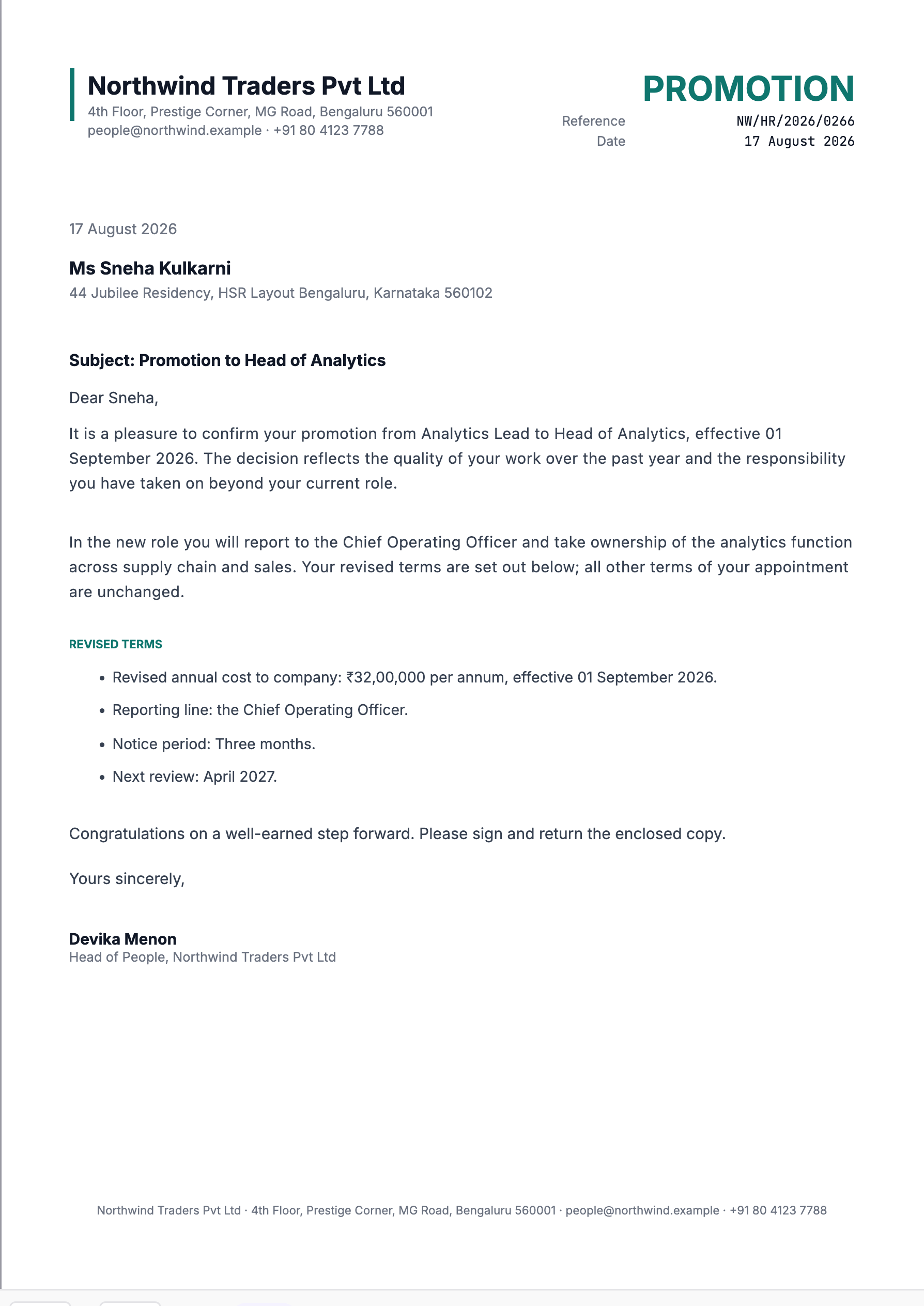
A promotion is agreed in a conversation and remembered differently by the two people who had it. The letter fixes the title, the date, the money and the reporting line in one place while everyone still agrees what was said.
What a promotion letter has to settle
| Field | Why |
|---|---|
| Previous and new title | The record needs both ends of the change. |
| Effective date | When payroll, records and reporting all change. |
| Revised CTC | The number, with the basis it is quoted on. |
| Reporting line | Who the employee reports to from that date. |
| Scope | What they now own, in one specific sentence. |
| Notice period | It often lengthens with seniority — a real change. |
| Signatory | Someone with authority to commit the organisation to salary. |
The effective date is a payroll instruction
Two dates sit on this letter and they do different work. The letter date is when you wrote it; the effective date is when the new terms begin, and it is the one payroll acts on.
Get the letter to payroll before their cut-off. Miss it and the first month goes out at the old rate, the correction lands as arrears the month after, and the employee spends four weeks wondering whether the promotion happened at all. A letter dated 17 August for a change effective 1 September leaves room; the same letter issued on 29 August does not.
If the effective date falls mid-month, say whether the revised figure is pro-rated from that date or applied for the whole month. Both are defensible. Leaving it unsaid is not.
Say whether the number is CTC or take-home
₹32,00,000 per annum cost to company is not ₹32,00,000 of salary, and the gap is wide enough to sour an otherwise good week. CTC in Indian practice absorbs the employer's provident fund contribution, gratuity provision, insurance and any variable component — none of which reach a monthly bank credit.
So label the figure — "revised annual cost to company" is doing real work in that sentence. Better still, reference the salary breakup showing basic, allowances, employer contributions and variable pay separately. The commonest complaint in the month after a promotion letter is that the credit does not match the number in it, and that is a labelling failure, not a payroll error.
A longer notice period is not a footnote
Moving someone from one month's notice to three is a genuine restriction. It affects their next move more than the title does, and it is the term most likely to be disputed a year later by someone who says they never noticed it. Put it in the revised terms list, in the same type size as the salary.
The line saying all other terms of the appointment are unchanged is load-bearing in the other direction: the original employment agreement still governs. Do not use a promotion letter to slip in a non-compete or a training bond that was not there before. If something else genuinely changes, list it where the employee will see it.
Record the old title, the scope, and the acknowledgement
Someone will need the previous designation eventually — for an employment verification, a background check, or a service certificate mapping dates to titles. This letter is often the only document carrying that boundary.
Scope deserves the same care. "The analytics function across supply chain and sales" tells the employee, their new peers and their old manager where authority now sits. A promotion with a new title and no stated scope is the one people later describe as a designation change rather than a real one.
Then get the countersigned copy back and file it with the original appointment letter. The signed copy shows the variation was accepted rather than sent.