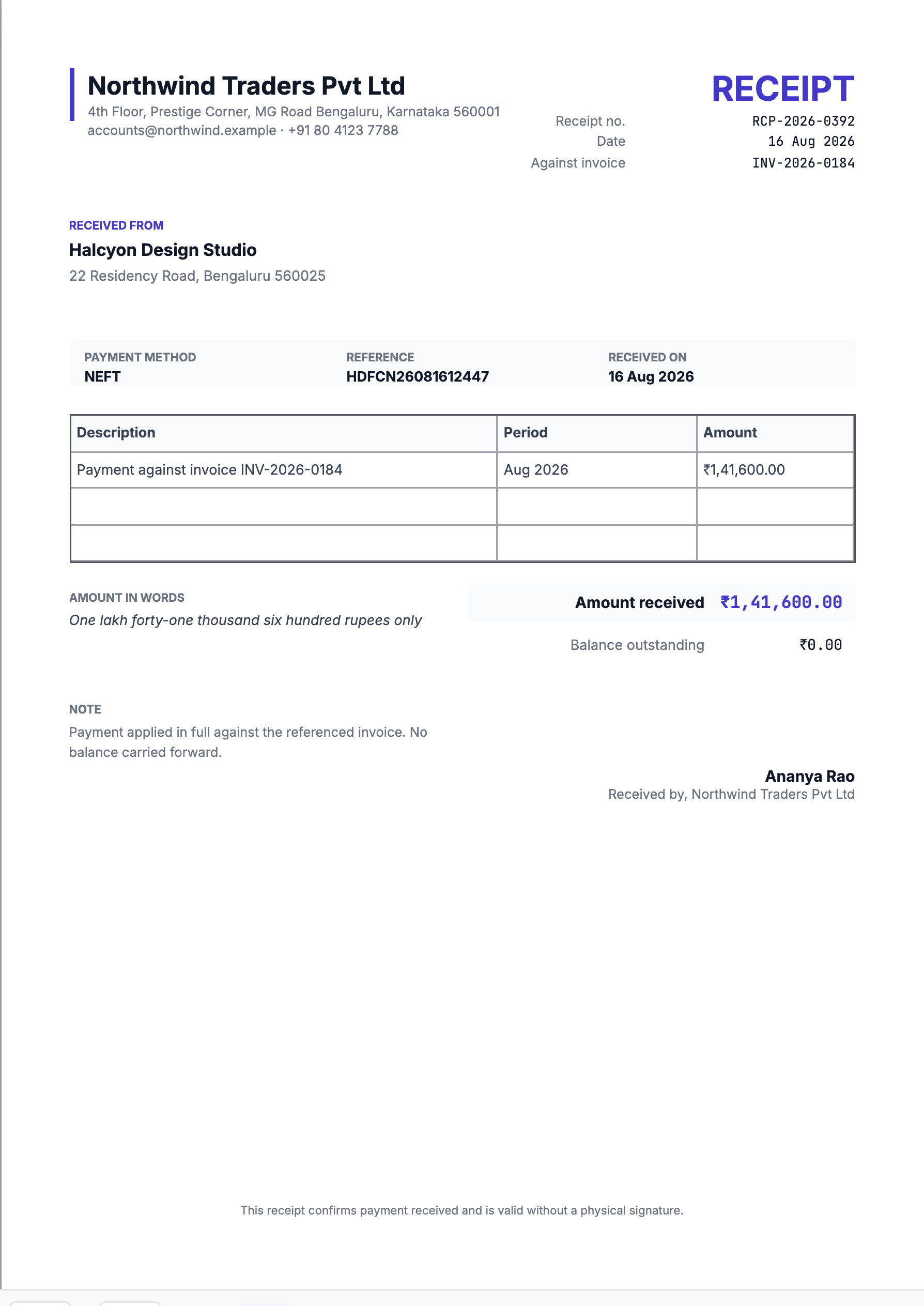
A receipt confirms money arrived. That sounds trivial until someone asks you to prove it — for a tax return, an expense claim, a deposit dispute, or a customer who is genuinely unsure whether they paid you in March.
The difference between a receipt that settles the question and one that starts another is almost always the same: whether it says what the payment was for.
What belongs on a receipt
| Field | Why |
|---|---|
| Receipt number | So this document can be referred to on its own. |
| Receipt date | When you issued it. |
| Payment date | When the money actually arrived — often a different day. |
| Received from | The paying entity. |
| Against | The invoice or agreement this settles. |
| Method | Cash, bank transfer, card, cheque, UPI. |
| Reference | The transaction ID, UTR or cheque number. |
| Amount | In figures, and in words for larger sums. |
| Balance | What, if anything, is still outstanding. |
Payment date and receipt date are not the same field
They usually differ by a day or two, and occasionally by much more — a cheque banked on Friday, a transfer that cleared over a weekend, a payment reconciled late. Both dates matter to different people: your accountant cares when the money moved, your customer cares when you acknowledged it.
The template has both. Filling them with the same value when they genuinely are the same is fine; collapsing them into one field is what causes the argument later.
Always show the balance
A receipt that shows only the amount received answers half the question. If your customer paid part of a larger invoice, the useful line is the one that says what is left.
Showing zero explicitly matters just as much. "Balance: ₹0.00" is a statement that the account is settled. A receipt with no balance line is silent on the point, and silence gets interpreted optimistically by whoever is reading it.
Reference numbers are what make reconciliation possible
The single most useful field on a receipt, for you rather than your customer, is the transaction reference. When someone queries a payment eighteen months later, the reference is what lets you find it in a bank statement in a minute rather than an afternoon.
Copy it exactly. A UTR with a transposed digit is worse than no UTR, because it sends whoever is searching down a dead end and they will assume the payment is missing rather than that the reference is wrong.
Receipts and invoices are different documents
Worth stating plainly, because they are often conflated. An invoice requests payment; a receipt confirms it. Marking an invoice "PAID" is not a receipt — it has no receipt number of its own, no payment date, and no reference. If you need to give someone proof of payment, give them a receipt.
If you issue a lot of these, generate them from your payment records rather than by hand. A receipt is one of the easiest documents to automate, because every field on it already exists in the system that recorded the payment.