A consultancy agreement is what stops a good working relationship becoming an argument about scope. Most of the disputes it prevents are not about the quality of the work — they are about how much time was promised, and who owns what was produced.
Scope should say how much time, not only what work
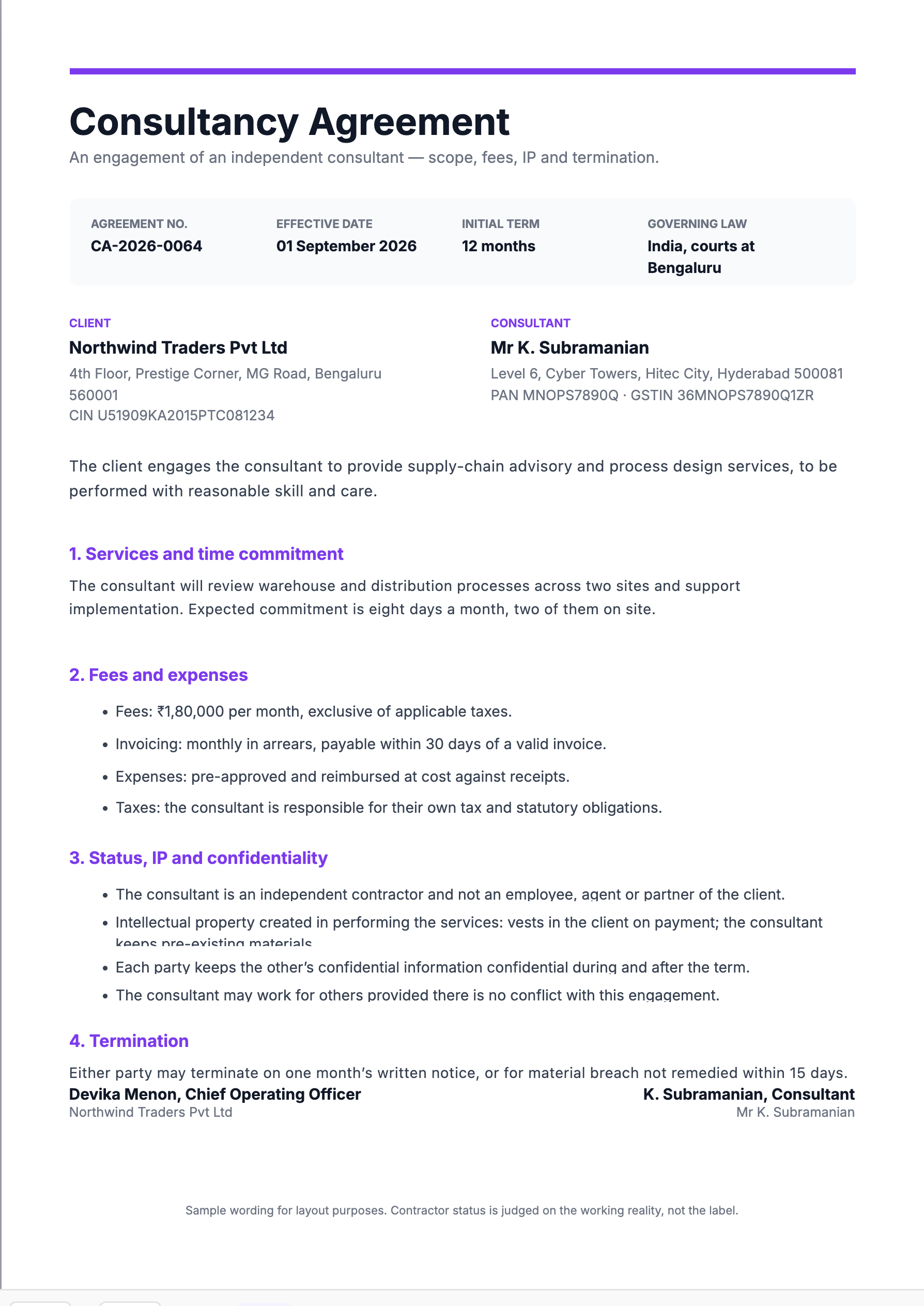
The sample scope does something many agreements skip: it puts a number on the commitment. "Eight days a month, two of them on site" is checkable by both sides, and it settles the question that otherwise surfaces in month three, when the client's team starts treating the consultant as permanently available and the consultant starts declining calls.
Pair that number with a day rate for anything beyond it. Once there is an agreed rate above the retainer, extra work becomes a purchase order rather than a grievance, and neither side has to decide whether raising it would be rude.
Describe the work as outcomes wherever you can. "Review warehouse and distribution processes across two sites and support implementation" can be assessed at the end of the term. "Provide supply-chain advisory services" cannot be assessed at all — it is a category, not a commitment, and it is the phrase both parties will read differently.
Fees, taxes and what makes an invoice valid
"₹1,80,000 per month, exclusive of applicable taxes" is doing necessary work in five words. Fees quoted without that phrase get argued about later, because one side assumed GST was inside the number and the other assumed it sat on top. State the basis once, where it cannot be missed.
"Within 30 days of a valid invoice" is the other phrase worth understanding properly. It means the payment clock starts when a correct invoice arrives, not when the work was done — so an invoice with the wrong GSTIN or a missing purchase order number can be returned and the thirty days start again. That is reasonable enough, provided the agreement or the first invoice makes clear what a valid invoice has to show. Agree it at the start and the finance team never becomes the reason payment slipped.
Fees paid to a consultant normally have tax deducted at source. Agree explicitly that the quoted figure is gross, so the deduction comes out of it rather than being added on top, and make sure the client issues the deduction certificate — without it the consultant cannot claim the credit and has effectively been paid less than the contract says.
Status, IP and confidentiality — one clause doing three jobs
Independent contractor status is a description of how an engagement actually runs, not a label an agreement can apply by asserting it. Fixed hours, an internal reporting line, a company laptop and an unspoken exclusivity expectation all point the other way. If the intent is genuinely a consultancy, let the consultant control how the work gets done, invoice for it, and take other clients.
Intellectual property in the sample vests in the client on payment, with the consultant keeping pre-existing materials. That is a fair default, but the second half needs a licence attached to be workable. A consultant's deliverable almost always embeds their own frameworks, models and spreadsheets. If the client owns the report and has no right to use the model inside it, the report is worth considerably less than it appears to be.
Termination: notice, cure and work in progress
One month's written notice, with a fifteen-day cure period for material breach, is a sensible shape. The cure period matters more than the notice period: it obliges an unhappy client to say what is wrong and allow a chance to fix it, rather than terminating on the strength of one bad fortnight.
What such agreements usually leave out is the handover. Say what happens to work in progress, whose data comes back and in what format, and whether the current month's fees are apportioned. Those three points are what people actually argue about once notice has been served — the termination clause itself is rarely the problem.
The sample wording is a starting point
These clauses are a drafting frame, not advice on your engagement. What is appropriate depends on the work, the sums involved and where both parties are based, and contractor status in particular is judged on the working reality rather than on what the paperwork calls it. Have the version you intend to sign reviewed — especially the IP and termination clauses, which are the ones that get tested.