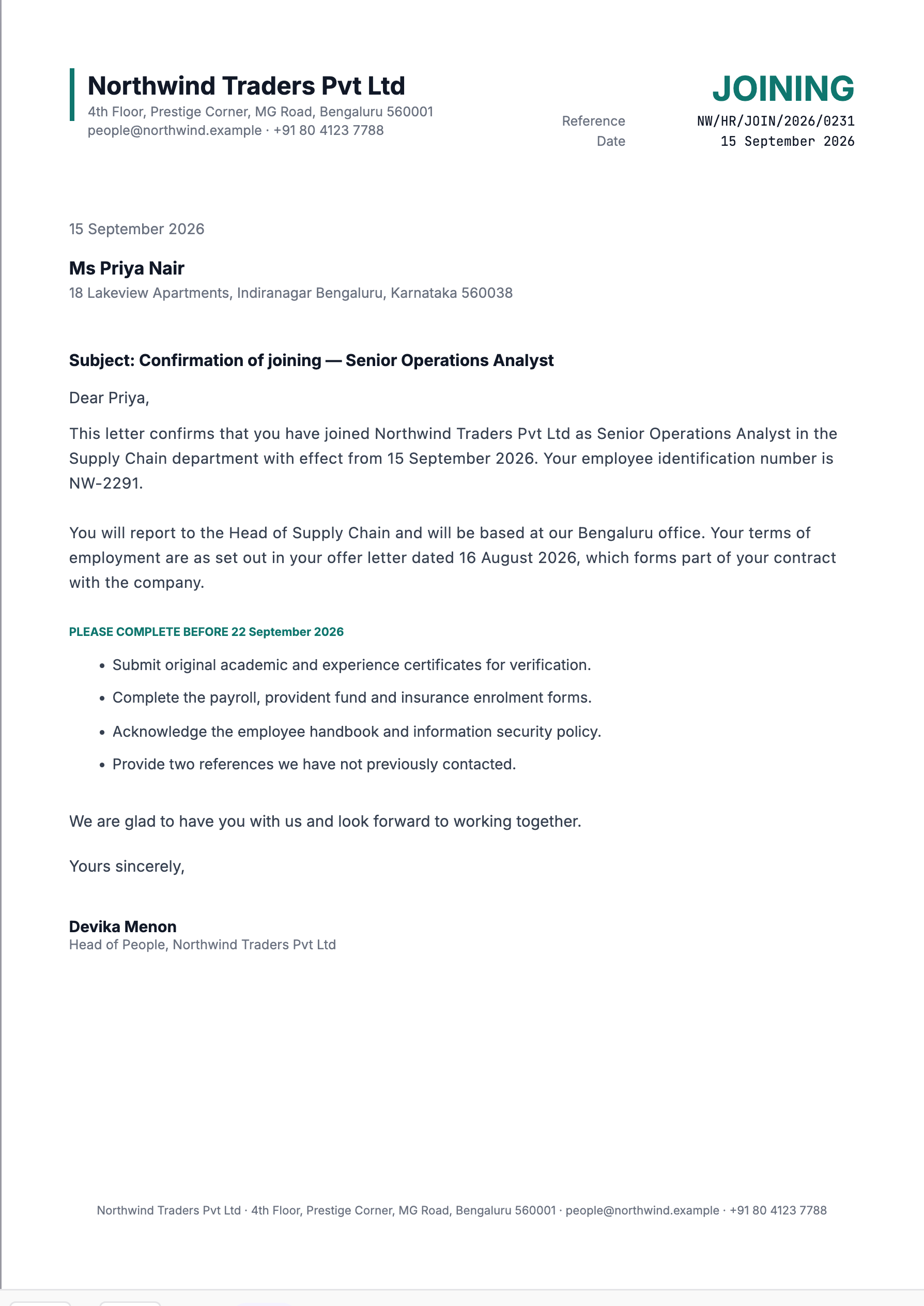
A joining letter records that someone has actually started. It sounds like a formality next to the offer letter, but it does two useful things: it fixes the date employment began, and it gives the new joiner a written list of what they still owe you.
That second part is why it is worth sending on day one rather than at the end of the first week.
Offer letter and joining letter are different
The offer is made before — it proposes terms and asks for acceptance. The joining letter is issued after — it confirms the employment has commenced on a particular date.
The distinction matters when dates move. If someone accepts an offer with a start date of 1 September and actually joins on the 15th, the joining letter records the 15th. That date is what drives probation, leave accrual, notice period and, eventually, the experience certificate. Getting it right once here prevents four downstream corrections.
What it should carry
| Field | Why |
|---|---|
| Date of joining | The date everything else is calculated from. |
| Employee ID | Their identifier in payroll and every internal system. |
| Designation and department | As it will appear on record. |
| Reporting line | Who they report to. |
| Work location | And the arrangement, if hybrid or remote. |
| Reference to the offer | So the two documents are linked. |
The reference to the offer letter matters more than it looks. It says that the detailed terms already agreed still apply, so this short letter does not accidentally become a replacement contract with fewer terms in it.
The document checklist
Every organisation has one, and it is nearly always communicated verbally and then chased for a month.
Putting it in the joining letter with a deadline does most of the work. The usual list:
- Original academic and experience certificates for verification
- Payroll, provident fund and insurance enrolment forms
- Acknowledgement of the employee handbook and information security policy
- References not already contacted
- Identity and address proof
Give a date, not "as soon as possible". People respond to dates.
Keep it short
The offer letter is where the terms live. The joining letter should be one page that a new colleague can read in two minutes on a day when they are already overwhelmed.
Resist the urge to restate the whole employment agreement here. If something genuinely was not covered in the offer, it needs its own conversation, not a paragraph in a confirmation letter.
Generate it from the same record as the offer
The joining letter repeats most of the offer's fields — name, title, department, reporting line, location. Retyping them is how a department name ends up different in two documents in the same file.
If you produce these from one candidate record, both documents stay consistent by construction, and issuing the joining letter becomes something that happens automatically on the start date rather than a task someone has to remember.