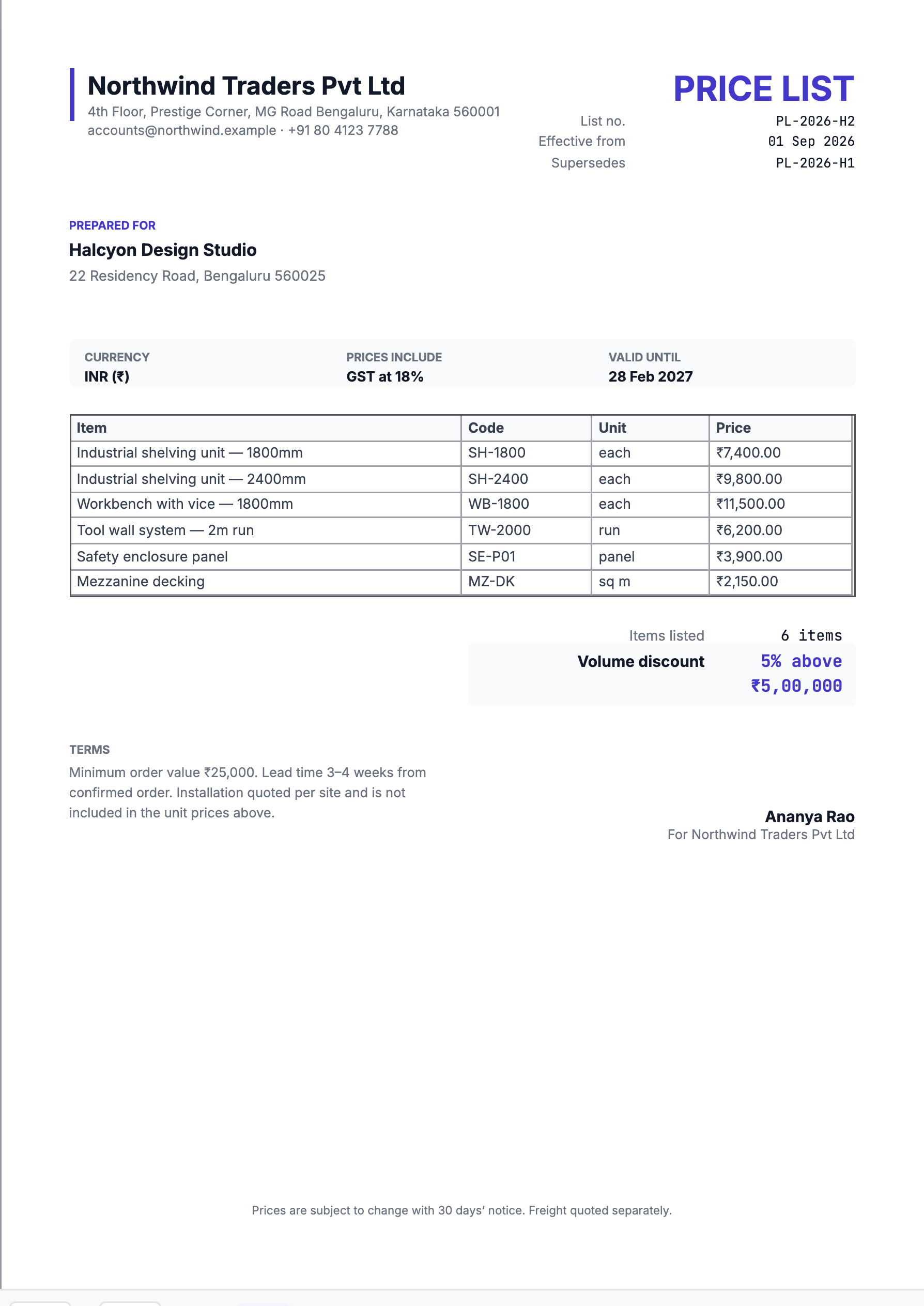
A price list is the document a customer quotes back at you six months later. That makes the dates on it — when the prices start, when they stop, and which list they replaced — as load-bearing as the numbers themselves.
Most price list disputes are not about whether a price is fair. They are about which price was in force, and whether tax was inside the figure or outside it.
What belongs on a price list
| Field | Why |
|---|---|
| List number | So a customer can say which list they are ordering from. |
| Effective from | The date these prices start applying. |
| Valid until | The date they stop. |
| Supersedes | The list this one replaces. |
| Prepared for | Named lists can carry negotiated pricing. |
| Currency | Never assume the reader knows. |
| Prices include | Whether GST is in the number or added to it. |
| Item, code, unit | What is priced, and per what. |
| Price | Per unit, in the stated currency. |
| Terms | Minimum order, lead time, what is excluded. |
Three dates that do three different jobs
Effective from is when the list starts. Valid until is when it stops. Supersedes points backwards at the list this one replaces — PL-2026-H2 replacing PL-2026-H1 on 1 September.
The supersedes field is the one people leave out, and it is the one that ends arguments. When an order arrives at a price you stopped honouring in March, the useful reply is not "our prices went up". It is "that figure is from PL-2026-H1, which PL-2026-H2 replaced on 1 September" — checkable by either side, because both lists carry their own numbers.
Say whether GST is inside the price
₹7,400 inclusive of 18% GST and ₹7,400 plus 18% GST differ by ₹1,332 a unit. On a forty-unit order that is over half a lakh of avoidable argument, and it surfaces when the invoice lands and does not match the budget the buyer built from your list.
Both conventions are normal. Retail lists tend to be inclusive, trade lists exclusive. Neither is wrong; silence is. The template carries a "Prices include" field near the top for exactly this — "GST at 18%", or "Exclusive of GST", in a place a reader sees before the numbers rather than in a footnote after them.
The unit column is doing more work than it looks
Shelving is priced per each, tool wall per 2 m run, mezzanine decking per square metre, enclosure per panel. A buyer who reads ₹2,150 for decking and assumes it is per sheet has built a budget wrong by whatever their sheet size is, and they will not discover it until the quotation arrives.
Fill the unit on every row, including the obvious ones. A blank unit gets read as "each" by everyone who reads it, and that assumption is silent — nobody rings to check.
Item codes earn their column the same way. SH-1800 and WB-1800 are both 1800 mm products; an order for "two of the 1800" is ambiguous, an order for two SH-1800 is not.
A price list is not a quotation
Worth stating plainly. A price list gives unit prices under stated conditions. A quotation prices a specific scope for a specific customer — quantities, freight, site work, lead time — and it is the document that becomes a number someone can approve.
The terms block and the footer line are what keep the two apart here: minimum order value, lead time, installation quoted per site, freight quoted separately. Without them, a list of unit prices gets read as a total, and the gap between that total and the real one is the whole margin on the job.