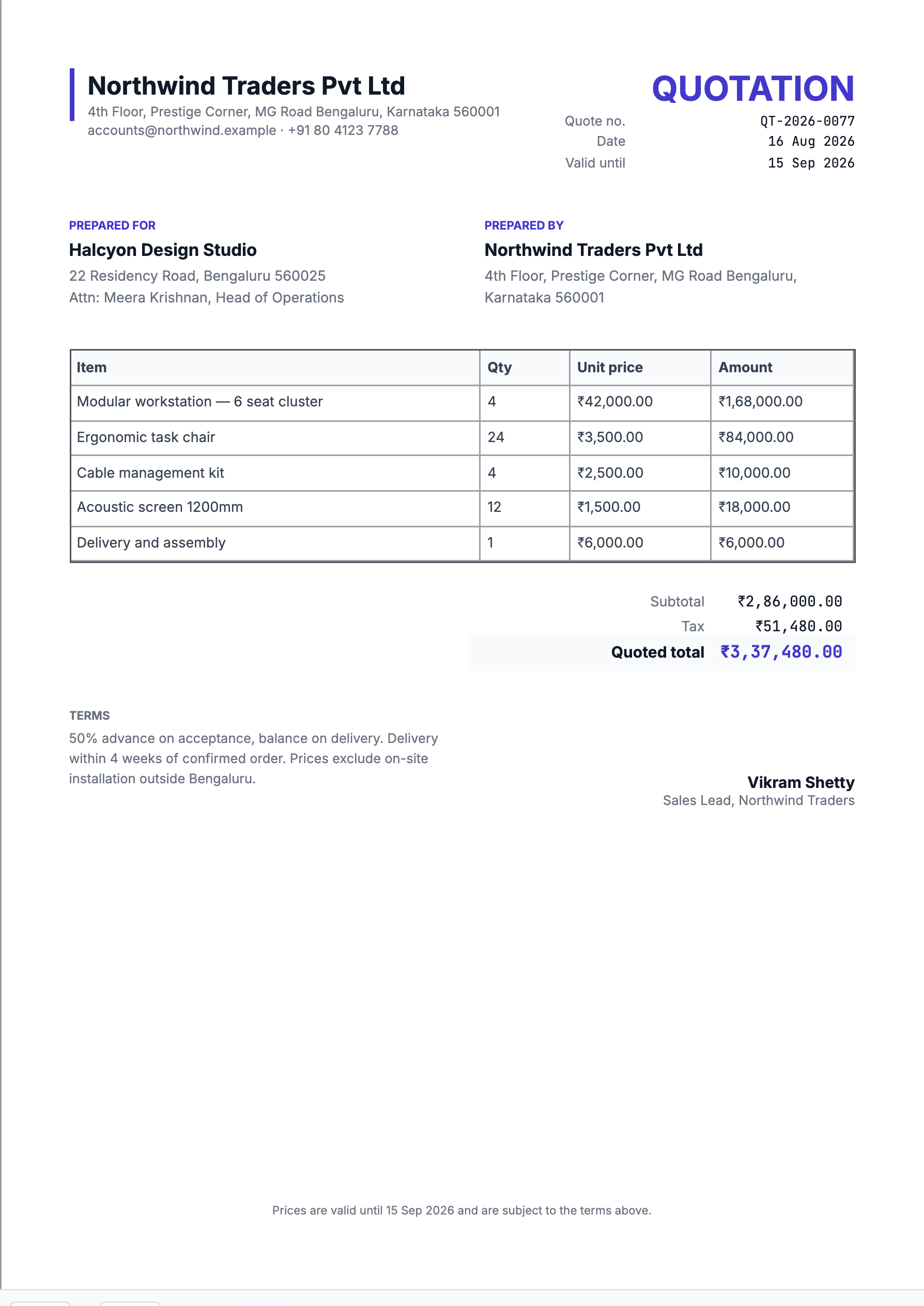
A quotation is a commitment with an expiry date. That is the whole design problem: you want it to feel firm enough to be trusted and bounded enough that you are not held to a price you gave eight months ago.
This template puts the validity date next to the quote number, at the top, where it cannot be missed.
Quotation, estimate, proforma — they are not the same
The words get used interchangeably and it causes real disputes.
A quotation is a fixed price for a defined scope. If the client accepts it within the validity period, that is the price.
An estimate is a considered guess. It signals that the final figure may differ, and it should say by roughly how much.
A proforma invoice looks like an invoice but is issued before supply — often so the buyer can raise a purchase order or arrange payment. It is not a demand for payment and should not be entered as one.
Use the right word in the title, because your client's finance team will file it according to what it says.
The validity date does more work than it looks
Without one, a quote is open-ended, and open-ended quotes get accepted after your costs have moved. Thirty days is a common default; pick whatever matches how fast your input prices actually change.
State it as a date, not a duration. "Valid for 30 days" requires someone to know when you sent it, and email dates are not always what people think.
Itemise, but do not itemise everything
There is a real tension here. Itemised quotes are easier to trust and easier to compare — which is good when you are the better option and less good when a client is line-shopping against a competitor who bundled.
The useful middle ground: itemise at the level of deliverables, not tasks. A client understands "brand identity design — full system" and can evaluate it. A list of forty hours broken into meetings, revisions and exports invites a negotiation about each one.
Terms that prevent the awkward conversation
The template has a terms block. The three lines worth having in it:
What triggers the work. Usually acceptance plus a deposit. Say which.
What is not included. Travel, third-party licences, printing, on-site installation. The exclusions are what prevent scope disagreements later, and they are much easier to state now than to argue after.
How changes are handled. Not a punitive clause — just a sentence saying that changes to scope are re-quoted. Clients generally find that reasonable when it is agreed in advance and unreasonable when it appears in an invoice.
After acceptance
A quote that gets accepted should turn into an invoice with matching line items. If the two documents disagree, someone has to reconcile them, and that person will assume the invoice is wrong.
The simplest way to keep them consistent is to build both from the same data. Same line items, same descriptions, same order — only the header changes.