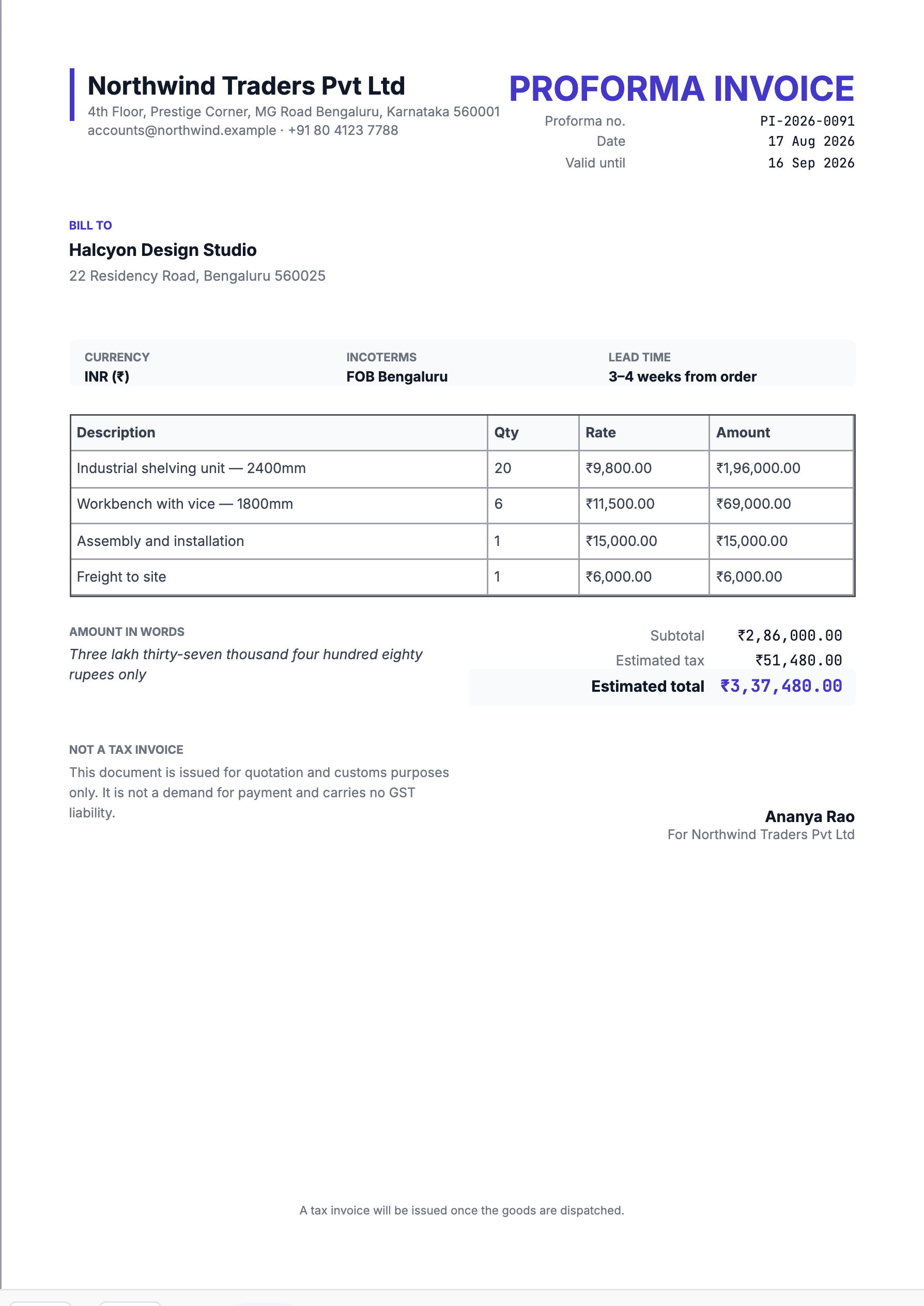
A proforma invoice is a priced commitment issued before anything ships — formal enough for a buyer to raise a purchase order against, open a letter of credit, or clear goods through customs. It looks almost exactly like an invoice, which is where most of the trouble with it begins.
A proforma is not a tax invoice
It creates no tax liability for you and no input tax credit for your customer. It is not recorded as a sale, it does not belong in a GST return, and it is not a demand for payment. The template says NOT A TAX INVOICE on the face of it and carries a disclaimer block underneath. Keep both — they are the parts doing the real work.
The failure this prevents is mundane and expensive: a buyer's accounts team books the proforma as a payable, then books the tax invoice that follows, and the same supply sits in the ledger twice. Somebody spends a morning finding it. Occasionally somebody pays it twice first.
What belongs on a proforma invoice
| Field | Why |
|---|---|
| Proforma number | Its own reference, in its own series. |
| Date | When the prices were quoted. |
| Valid until | The date the quote stops binding you. |
| Bill to | The buying entity, at the address the order will come from. |
| Currency | Stated explicitly, not implied by the symbol. |
| Incoterms | Who bears freight, insurance and risk, and to what point. |
| Lead time | Measured from order, not from the date of this document. |
| Line items | Description, quantity, rate, amount. |
| Estimated tax | Flagged as an estimate, because it is one. |
| Estimated total | And the same figure in words. |
Valid until is the field doing the real work
A quote without an expiry binds you indefinitely, and buyers do come back six months later with a printed proforma and an expectation. Steel prices move, freight moves, the rupee moves. Thirty days is a reasonable default for goods with volatile input costs; ninety is normal for services.
The date also creates useful pressure. A proforma valid until 16 September is a reason for the buyer's procurement team to get the approval through in August, which is frequently the actual purpose of issuing one.
Currency, Incoterms and lead time
These three fields decide almost every dispute that follows, and the template puts them in a band across the page rather than burying them in terms at the bottom.
Currency should be written out — "INR (₹)" rather than a bare symbol. Cross-border buyers deal in several currencies and their systems guess badly.
Incoterms determine who pays for what. "FOB Bengaluru" means your responsibility ends when the goods are loaded; freight and insurance beyond that are the buyer's. If you quote a delivered price and write FOB, you have quoted two different deals in one document.
Lead time should always name its starting point. "3–4 weeks from order" is a commitment you can keep. "3–4 weeks" alone gets read as three weeks from the day the proforma landed, and the clock starts running before you have an order.
Number proformas in their own series
Use a distinct prefix — PI-2026-0091 rather than a number from your invoice run. Tax invoice numbers must be unique and sequential, and a proforma that consumes one leaves a gap you will have to explain.
When the order converts, issue a fresh tax invoice with its own number and reference the proforma on it. The two documents are then linked in both directions, which is what anyone reconciling the file eight months later is looking for. Amounts may legitimately differ between them — actual quantities, actual freight, actual tax — and that is fine as long as the trail is visible.