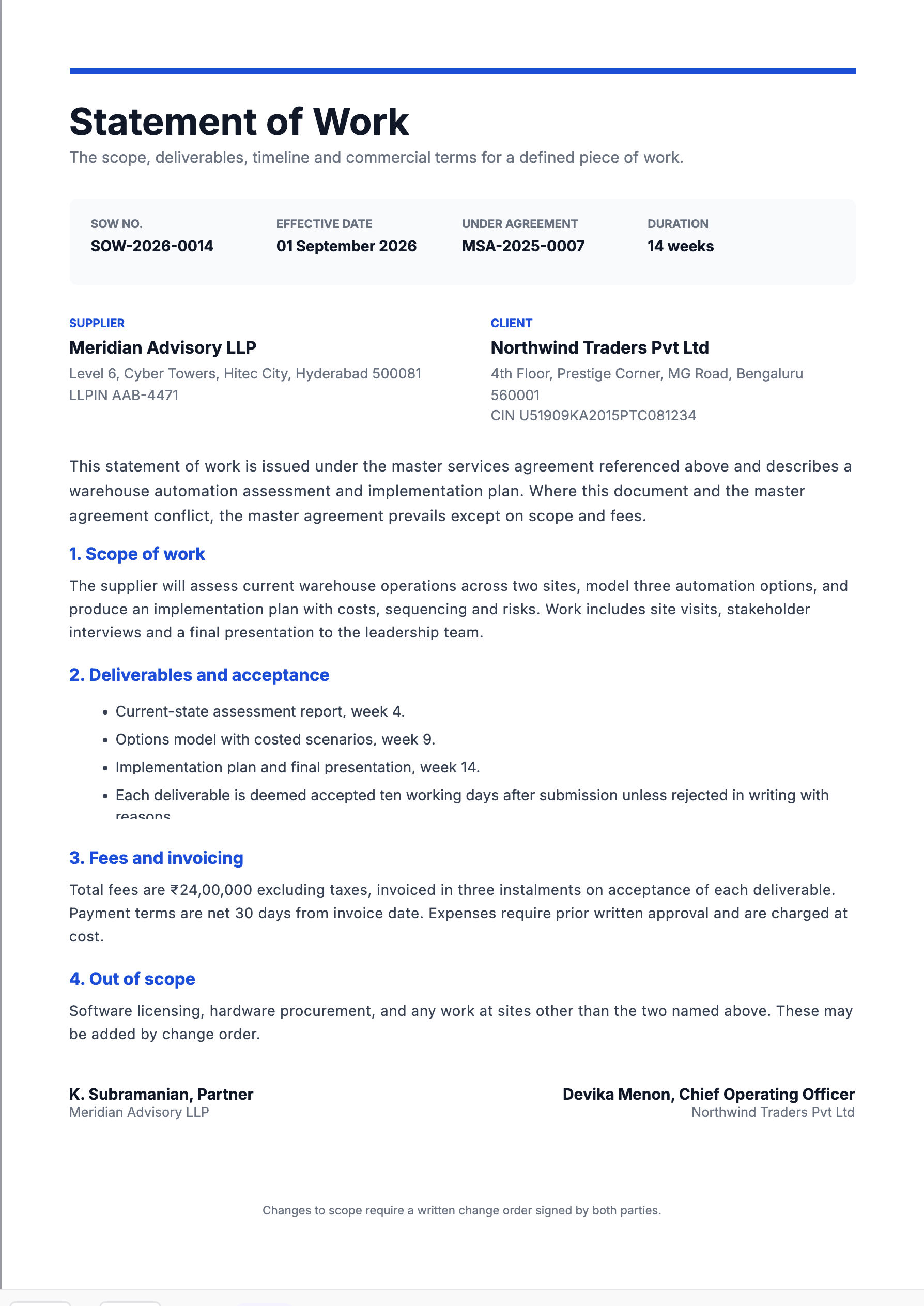
A statement of work is where a proposal stops being a conversation and becomes an obligation. It is also the document both sides read again, line by line, on the day something goes wrong — usually to establish whether a particular piece of work was ever promised.
What a statement of work has to settle
| Field | Why |
|---|---|
| SOW number | So invoices, change orders and emails can refer to it. |
| Effective date | The date every relative deadline counts from. |
| Master agreement | Which contract governs everything not stated here. |
| Duration | How long the engagement runs. |
| Supplier and client | Legal names, addresses and registration — CIN or LLPIN. |
| Scope | What will be done, in enough detail to be checkable. |
| Deliverables | Each with a date and something that can be accepted. |
| Acceptance window | How long the client has to reject before it is deemed accepted. |
| Fees | With the tax treatment stated. |
| Invoice schedule | When you may raise an invoice. |
| Payment terms | When it falls due, and from what date. |
| Out of scope | What is deliberately excluded. |
| Signatures | Both sides, with each signatory's role. |
Out of scope earns its place
Scope paragraphs are read generously by whoever is paying. "Model three automation options" quietly acquires a fourth. "A final presentation" acquires a board pack the week before. Neither side is behaving badly — the scope was written before anyone knew what the work would feel like.
Naming exclusions is what stops the drift: software licensing, hardware procurement, any work at sites other than the two named. The wording matters as much as the list — say the excluded items may be added by change order rather than simply refusing them. An exclusion with a route through it becomes a price conversation; an exclusion without one becomes an argument.
Deliverables need a date and a way to be accepted
"Current-state assessment report, week 4" beats a calendar date. A project that starts a fortnight late drags every calendar date with it, and nobody wants to reissue a signed SOW to fix arithmetic. Number the weeks from the effective date, which the header of this template already carries.
Acceptance is what decides whether you get paid. If invoices are raised on acceptance of each deliverable, a client who simply does not reply has stopped your cash flow without ever saying no — and has not breached anything, because nothing obliged them to answer. Deemed acceptance closes that: accepted ten working days after submission unless rejected in writing, with reasons.
"With reasons" is not decoration. A rejection you cannot act on is indistinguishable from silence, and it restarts the same clock indefinitely.
It sits under the master agreement, deliberately
An SOW is normally issued under an MSA that already carries the liability cap, IP ownership, confidentiality, insurance and termination rights. Reference it by number — MSA-2025-0007, not "our agreement" — and state the order of precedence: the master agreement prevails, except on scope and fees.
That carve-out is the whole design. You do not want a SOW drafted in an afternoon quietly rewriting a liability cap that took three weeks to negotiate, and you do not want generic wording overriding the specific scope you have just agreed. If there is no MSA behind this document, it is doing all of that work alone, and it needs considerably more than four numbered sections.
Fees, tax and expenses
State whether fees include GST. ₹24,00,000 excluding taxes and ₹24,00,000 including taxes are more than ₹3.6 lakh apart at 18%, and that ambiguity surfaces at invoice stage, between two accounts teams, with neither signatory in the room.
Payment terms should say what the clock runs from. Net 30 from invoice date is not net 30 from acceptance, and where deemed acceptance applies those two dates can sit a fortnight apart. Expenses at cost with prior written approval, always — an expenses line without an approval gate is a second budget nobody agreed to.